Cryotherapy for Sports Recovery in Toronto
Train hard, recover harder. Three minutes at −195°C reduces DOMS, speeds muscle recovery, and gets you back to your next session fresh — without medication or downtime. One of Toronto's longest-operating cryotherapy centres, 15,000+ sessions delivered.
The Short Answer
Cryotherapy for sports recovery in Toronto is offered by Cryotherapy Toronto in North York, where athletes use 2–3 minute whole body sessions to manage soreness between training days. Two to three visits a week is where most clients with athletic goals see the best results; the first trial costs $40 plus HST, and packages never expire.
- $40 first visit
- Free consultation
- 5.0★ · 135+ Google reviews
- 4646 Dufferin St, North York
Key Takeaway
Cryotherapy for sports recovery uses 2–3 minutes of −195°C dry nitrogen vapour to reduce inflammation, blunt delayed onset muscle soreness (DOMS), and accelerate muscle recovery between training sessions. It is faster and more tolerable than an ice bath, drug-free, and used by everyone from professional athletes to weekend warriors across the GTA.
Why Toronto Athletes Use Cryotherapy for Recovery
Recovery is where adaptation happens. Cryotherapy shortens the gap between hard sessions so you can train more often, at higher quality, with less accumulated soreness.
Reduced DOMS
Cut delayed onset muscle soreness after heavy training so you can hit your next session at full intensity instead of limping through it.
Faster Muscle Recovery
Lower inflammatory markers and creatine kinase after intense training, helping fatigued muscle tissue recover between sessions.
Higher Training Volume
Recovering faster means training more often. Athletes use cryotherapy to sustain heavier weekly loads without breaking down.
Less Joint Pain
Systemic anti-inflammatory response eases the chronic aches that accumulate in knees, shoulders, and lower back over a season.
Better Sleep & Energy
Norepinephrine and endorphin release after a session commonly improves sleep quality and next-day energy — when recovery actually happens.
Drug-Free Recovery
No NSAIDs, no needles, no downtime. A 3-minute session with no recovery period and nothing that conflicts with drug testing.
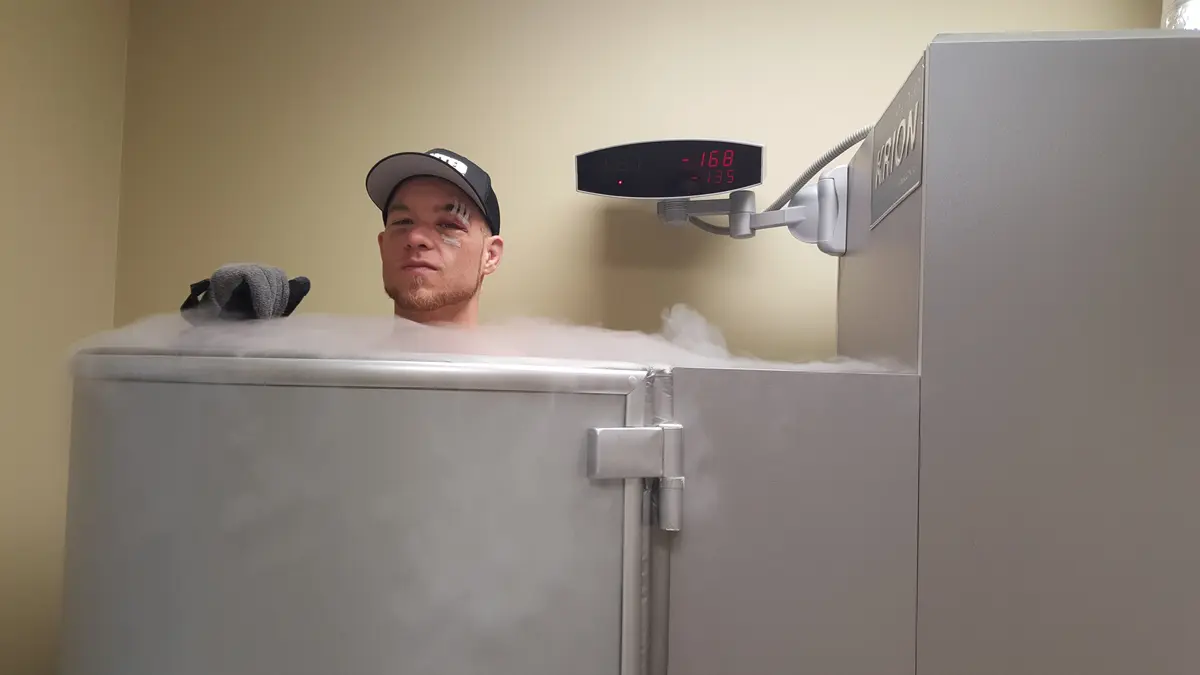
How Cryotherapy Speeds Muscle Recovery
Hard training creates micro-damage and inflammation in muscle tissue. That is normal and necessary — but left unmanaged it becomes the soreness that wrecks your next session. Here is what happens during a 3-minute cryotherapy session:
- Vasoconstriction: surface blood vessels narrow rapidly, reducing inflammatory swelling in fatigued muscle.
- Endorphin & norepinephrine release: natural pain relief that lowers the perception of soreness.
- Inflammatory markers drop: studies on whole body cryotherapy report reduced creatine kinase and inflammatory cytokines after intense exercise.
- Vasodilation rebound: on exit, vessels reopen and flood muscle with oxygen- and nutrient-rich blood.
- Metabolic clearance: improved circulation helps flush the waste products that accumulate during hard training.
- Nervous system reset: many athletes report deeper sleep the night of a session — where real recovery occurs.
Cryotherapy for DOMS: Timing Matters
Delayed onset muscle soreness peaks 24–72 hours after hard training. When you book determines how much benefit you get.
Best for DOMS Prevention
The highest-value window. A session the morning after leg day, a long run, or a hard sparring round blunts the inflammatory response before soreness fully sets in.
Best for Active Soreness
Already sore? Cryotherapy still reduces pain perception and inflammation, shortening how long DOMS lingers and getting you moving properly again.
Best for Performance
A session before competition increases alertness and reduces existing joint stiffness — useful when you need range of motion on game day.
Cryotherapy for Athletes in Toronto
You do not need to be a professional. Most of our recovery clients simply train hard and want to train again sooner.
Runners & Triathletes
Manage the repetitive impact load of high-mileage weeks. Cryotherapy helps with shin, knee, and calf soreness between long runs and race blocks.
Weightlifters & CrossFit
Recover from heavy squat and deadlift sessions. Reduce the DOMS that makes back-to-back training days unproductive.
Hockey & Team Sports
Sustain performance across a long season of games and practices, when there is no time for a full week of passive rest.
Combat Sports
Muay Thai, jiu-jitsu, boxing, and MMA athletes use cryotherapy to recover from sparring impact and heavy conditioning.
Weekend Warriors
Train hard around a full-time job. Get back to Monday feeling recovered instead of wrecked from the weekend.
Post-Injury Rehab
Support physiotherapy and rehab work by controlling inflammation and pain around a healing joint or muscle.
Build Your Recovery Stack
Most athletes combine treatments. Whole body cryotherapy handles systemic recovery; the others target what is specifically bothering you.
Whole Body Cryotherapy
The core of athletic recovery — 2–3 minutes at −195°C for full-body inflammation control and DOMS relief.
Learn moreLocalized Cryotherapy
Concentrated cold on one problem joint or muscle — the sore knee, shoulder, or hamstring holding you back.
Learn moreCompression Therapy
Pneumatic compression to flush the legs after long runs or heavy lower-body training.
Learn moreWhy Athletes Choose Cryotherapy Toronto
Since 2013
One of Toronto's longest-operating cryotherapy centres, with 15,000+ sessions delivered and 135+ five-star Google reviews.
Real Athlete Experience
From NBA visitors like Jimmy Butler to Toronto's combat sport and endurance communities — we know recovery protocols.
In and Out in Minutes
A session takes 2–3 minutes with no downtime. Fit it around training, not the other way around.
Packages Never Expire
Load up during your season, pause in the off-season. Your sessions are there when your training demands them.
Cryotherapy for Sports Recovery FAQ
Does cryotherapy really help with muscle recovery?
How does cryotherapy help with DOMS?
When should an athlete do cryotherapy — before or after training?
How often should athletes do cryotherapy for recovery?
Is cryotherapy better than an ice bath for recovery?
Which athletes use cryotherapy in Toronto?
How much does cryotherapy for sports recovery cost in Toronto?
Will cryotherapy help an existing sports injury?
More on Cryotherapy & Recovery
Cryotherapy for Muscle Recovery in Toronto
Read guideCryotherapy vs Ice Bath: Recovery Comparison
Read guideAthletes Using Cryotherapy
Read guideElite Athlete Cryotherapy Recovery Secrets
Read guideCryotherapy Muscle Recovery: 10 Facts for Athletes
Read guideFreeze Therapy for Athletes: Ice Bath vs Cryotherapy
Read guideBuilding Cryotherapy Into Your Training Week
Most athletes who visit our North York studio know the theory. What they want is a routine that fits around practices, races and a day job. Here's how we help clients make cryotherapy for sports recovery in Toronto a habit rather than an occasional extra.
Anchor sessions to your hardest days
Two to three visits a week is the range where most clients with athletic goals see the best results. Rather than booking at random, tie them to the workouts that leave you most sore: the heavy lower-body day, the long run, the hard sparring round. If you're using cryotherapy for DOMS, come in before the soreness has had days to build. Your technician will suggest a schedule after your consultation, and our guide on how often to do cryotherapy covers frequency in more depth.
Stack the right add-on
- Legs heavy after a big week? Add NormaTec compression boots.
- One nagging zone? Localized cryotherapy focuses cold air on a single area such as an ankle, hip or elbow.
- Combining services? Ask about Bundle & Save add-ons, from $30.
Coming straight from the gym
Your skin must be dry before a whole body session, so towel off well or change out of sweaty kit first. The only kit you need is underwear, plus a sports bra for women; gloves, socks, slippers and ear protection are on us.
What a season of sessions costs
- Ten sessions for $500 work out to $50 each; fifteen for $720 bring it to $48, all plus 13% HST.
- Packages never expire, so an off-season break doesn't waste anything.
- Packages are tied to the purchaser, so teammates can't split one; gift cards are the way to share with a training partner.
An honest note for athletes
Research on cryotherapy for muscle recovery is mixed, and it won't replace sleep, nutrition or sensible load management. Many clients find it helps them feel fresher between sessions, which is why we suggest tracking how you feel and adjusting. Whether you're a weekend runner or one of the hockey players and MMA fighters who visit us, cryotherapy for athletes in Toronto works best as one part of a bigger plan, and cryotherapy for recovery pays off most when it's consistent. See full pricing to plan ahead.