Whole Body Cryotherapy Benefits: What the Evidence Says (2026)
Key Takeaway
The strongest whole body cryotherapy benefits are short-term pain relief, reduced inflammatory markers, improved mood, and a reliable lift in energy and alertness. Benefits for muscle soreness are widely reported but the research is mixed. Claims about significant weight loss or "detoxing" are not supported. This article separates the two.
Ask the internet whether cryotherapy works and you will get two answers, both wrong. One says it is a miracle cure for everything from arthritis to obesity. The other says it is an expensive placebo. After 13 years and more than 15,000 sessions at our North York centre, the honest answer sits in between — and it is genuinely useful once you know which is which.
This is an evidence-first look at what whole body cryotherapy is actually good for. Where the research is solid, we will say so. Where it is thin — and in a few places it is very thin — we will say that too. If you are trying to decide whether cryotherapy benefits justify the cost, this should give you a straight answer.
First, what actually happens in the chamber
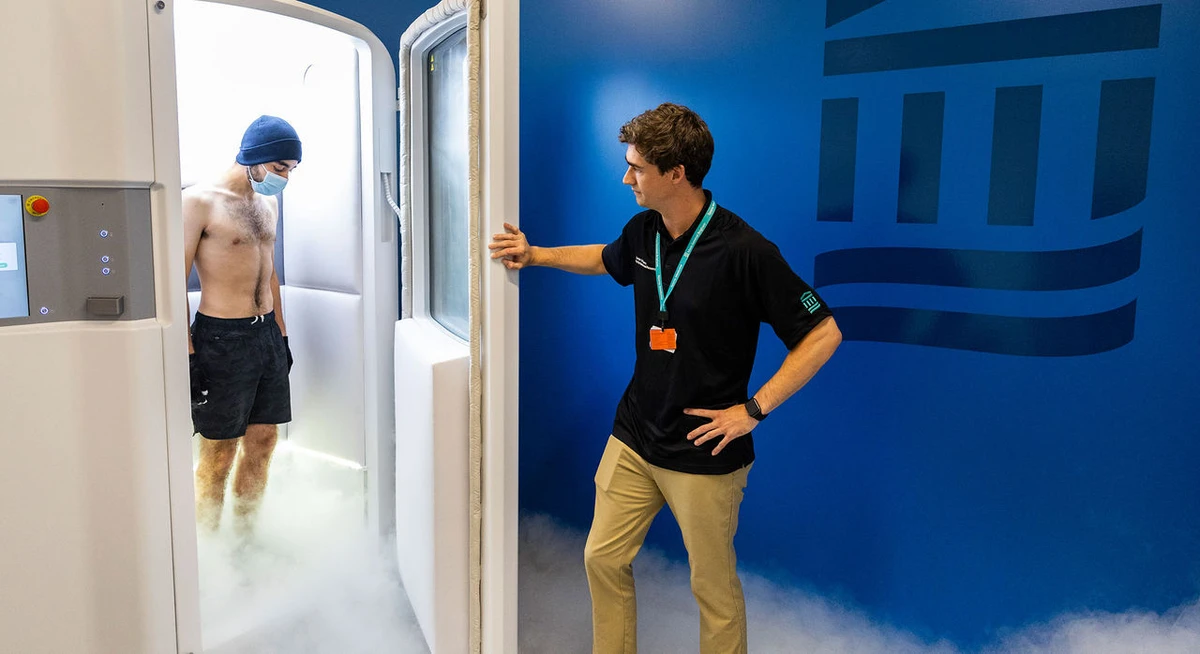
Whole body cryotherapy exposes your skin to dry nitrogen vapour at roughly −110°C to −195°C for two to three minutes. Your head stays above the chamber the entire time, so you never breathe the vapour. It is not an ice bath — the cold is dry, so it feels far less punishing than immersion, and the exposure is a fraction of the length.
Physiologically, three things happen. Your surface blood vessels constrict sharply, pulling blood toward your core. Your body releases a substantial surge of norepinephrine and endorphins. Then, when you step out, those vessels reopen and blood floods back through the tissue. Nearly every real benefit of cryotherapy traces back to one of those three mechanisms — which is a useful filter. If a claimed benefit cannot be explained by vasoconstriction, hormone release, or the vasodilation rebound, be sceptical.
What the evidence supports well
1. Short-term pain relief
This is the best-established benefit. The norepinephrine and endorphin release following cold exposure measurably reduces pain perception, and the effect is immediate. Cold therapy has been used in European rheumatology clinics since the 1970s specifically for pain in inflammatory conditions, and studies in rheumatoid arthritis and ankylosing spondylitis have reported reduced pain scores and disease activity in the short term.
The important caveat: the relief is short-term. A session does not repair a joint. What it does is give you a window of reduced pain — which, for someone managing a chronic condition, can be the difference between a functional day and a lost one. This is why we recommend consistency over one-off visits for arthritis and chronic pain.
2. Reduced inflammatory markers
Multiple studies measuring blood markers before and after whole body cryotherapy have found reductions in pro-inflammatory cytokines such as IL-1β, IL-6, and TNF-α, along with increases in anti-inflammatory mediators like IL-10. Reductions in C-reactive protein have also been reported. This is measurable biochemistry, not subjective reporting, which is what makes it credible.
What is less settled is how much those marker changes translate into long-term clinical outcomes. Lower IL-6 on a blood panel is not the same thing as a better life six months from now. The mechanism is real; the long-term significance is still being worked out.
3. Energy and alertness
If you want the most reliable, most immediately noticeable effect of cryotherapy, this is it. Cold exposure triggers a large norepinephrine release — studies have measured increases of several hundred percent following whole body cryotherapy. Norepinephrine drives alertness, focus, and mood.
Practically, most people walk out feeling sharply awake and stay that way for several hours. It is the single most consistent piece of feedback we hear, and it is why cryotherapy for energy has become a genuine use case rather than a side effect. A morning session before a demanding day is a legitimate reason to book.
4. Mood
The same norepinephrine and endorphin response that drives alertness also affects mood, and several small studies have reported improvements in mood and reductions in anxiety and depressive symptoms following cryotherapy courses. The studies are small and the effect sizes vary, so this is "promising" rather than "proven" — but the mechanism is sound and the subjective reports are near-universal.
What is genuinely mixed
5. Muscle recovery and DOMS
Here is where we have to be careful, because this is cryotherapy's most marketed benefit. Plenty of studies report reduced creatine kinase (a marker of muscle damage) and lower perceived soreness after cryotherapy. But a well-known Cochrane review of whole body cryotherapy for preventing and treating muscle soreness concluded there was insufficient high-quality evidence to support or refute its use — largely because the studies were small, varied wildly in protocol, and rarely blinded.
So what do we make of that? "Insufficient evidence" is not the same as "does not work" — it means the research has not been done well enough to say. Meanwhile the subjective experience is consistent enough that a great many professional teams use it anyway. Our own view: it is worth trying for sports recovery, most athletes find it helps, and you should judge it on your own results rather than on marketing claims in either direction.
One nuance worth knowing: because inflammation plays a role in training adaptation, some researchers suggest heavy cold exposure immediately after resistance training might slightly blunt hypertrophy gains. If muscle growth is your single priority, leave a few hours between lifting and your session.
6. Sleep
Cryotherapy for sleep is one of the most common things clients report back to us unprompted — better sleep quality on session nights. The mechanisms are plausible: less pain, lower inflammation, endorphin release, and a nervous-system down-regulation after the initial cold stress.
But direct research on cryotherapy and sleep is limited and mostly small-scale. We would call this commonly reported and mechanistically sensible — not established. Given that poor sleep amplifies pain sensitivity, and pain disrupts sleep, breaking that cycle is valuable if it works for you.
What is overhyped
Claims we would not make
- Significant weight loss. A session burns a modest number of calories. The "800 calories per session" figure circulating online is not supported. Cryotherapy is not a weight-loss strategy, and anyone selling it as one is not being straight with you.
- "Detoxing" or removing toxins. This is marketing language with no physiological meaning. Your liver and kidneys handle that.
- Curing chronic disease. Cryotherapy manages symptoms. It does not cure arthritis, reverse joint damage, or treat disease.
- Replacing medical care. Whole body cryotherapy is not FDA-approved as a medical treatment. It complements your care; it does not replace it, and you should never stop prescribed medication because of it.
Who it is genuinely worth trying for
- People managing arthritis, fibromyalgia, or chronic inflammatory pain who want a drug-free tool alongside their existing treatment.
- Athletes and active people who train hard and want to reduce soreness between sessions.
- Anyone whose chronic pain is disrupting sleep, where breaking the pain-sleep cycle would change their week.
- People who want a reliable, immediate energy and mood lift without stimulants.
- Anyone who has hit a wall with NSAIDs and wants to reduce how often they reach for them.
And who it is not for: anyone with the contraindications — uncontrolled hypertension, severe cardiovascular or respiratory conditions, Raynaud's syndrome, cold allergy, or pregnancy among them. That list is not a formality. Tell us about your conditions at your consultation.
The bottom line
Whole body cryotherapy is a legitimate tool with a real mechanism and real limits. It is very good at short-term pain relief, reducing inflammatory markers, and delivering energy and mood benefits. It is probably helpful for muscle recovery, though the research has not caught up to the practice. It is not a weight-loss device, a detox, or a cure.
If that sounds like something worth testing on your own body, that is exactly what the $40 first-time trial is for. It includes a consultation where we will tell you honestly whether we think it will help you — and occasionally we tell people it will not.
Ready for the next step?