A practical, evidence-checked checklist for comparing any cryotherapy clinic, studio or spa in Toronto and the GTA, from equipment and supervision to pricing and red flags. Written by the Cryotherapy Toronto team, founded in 2013.
Key takeaways
- Compare any Toronto cryotherapy provider on 12 points: equipment, supervision, time cap, screening, protocol, protective gear, evidence, pricing, track record, location, targeted options and staff explanations.
- Safety comes from process: a 2023 international review concluded whole-body cryotherapy risks can be proactively prevented by following recommendations and contraindications.
- Evidence for benefits is still limited, so an honest studio says “may” and never promises results.
- Do the per-session math with 13% HST and check package expiry and transfer rules before you buy.
- Red flags include no health screening, unsupervised sessions and promises to fix medical conditions or produce weight loss.
What is the best cryotherapy in Toronto? The 12-point checklist
Quick answer: The best cryotherapy in Toronto is a studio that tells you exactly what equipment it uses, screens your health first, keeps a trained technician with you for every session, sets a firm time limit, provides protective gear, publishes clear prices and is honest that research on the benefits is still limited.
These are the questions we would ask if we were choosing a cryotherapy clinic in Toronto or the GTA ourselves. They work whether a provider calls itself a cryotherapy spa, clinic or studio, and you can use them on us too.
| # | Checkpoint | Ask the studio | A good answer |
|---|---|---|---|
| 1 | Equipment type | What machine is it, and is my head inside or outside the cold? | Names the type and explains the difference |
| 2 | Supervision | Will someone be with me the whole time? | Yes, a trained staff member for every session |
| 3 | Session cap | What is the maximum time? | A firm limit of a few minutes, enforced by staff |
| 4 | Health screening | Do you check for contraindications? | A health history and contraindication review before session one |
| 5 | Temperature and time | What temperature, how long, and why? | Specific numbers and a reason |
| 6 | Dry skin and protective gear | What do I wear, and what do you provide? | Dry skin, minimal clothing, gloves, socks, footwear and ear protection |
| 7 | Evidence | What does research actually show? | “May help”, with honest limits |
| 8 | Pricing | What is the per-session cost with tax, and do packages expire? | Published prices, tax stated, clear expiry and transfer rules |
| 9 | Track record | How long have you operated? | Years in business, many detailed reviews |
| 10 | Location and hours | Where are you, and when can I book? | A clear address, access notes and posted hours |
| 11 | Localized and cryofacial options | Can you treat just one area, or my face? | Targeted options with clear zone rules and prices |
| 12 | Staff explanations | What will I feel, and how often should I come? | A plain explanation and a personalised plan, without pressure |
Which type of cryotherapy equipment should you look for?
1. Equipment type: cryosauna, electric chamber or localized device
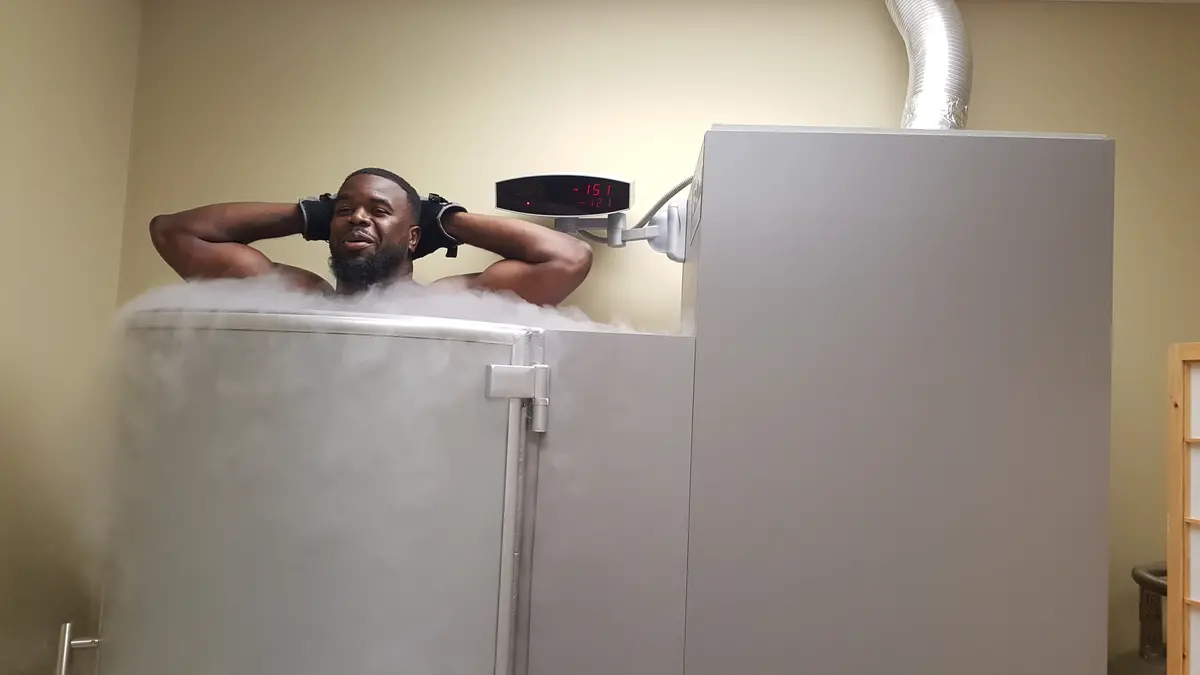
“Cryotherapy” covers several different machines, so first ask what you will be standing in. The FDA describes two whole-body set-ups: a single-person, open-top enclosure where your head stays above the cold at room temperature, and a fully enclosed chamber where the whole body, head included, is exposed (FDA, 2016). Researchers often call the head-out nitrogen cabin “partial-body cryotherapy” and keep “whole-body” for enclosed chambers (Legrand et al., 2023). Many studios, ours included, use “whole body” for both.
| Type | How it works | Your head | Good to ask |
|---|---|---|---|
| Nitrogen-vapour cryosauna | Single-person, open-top cabin cooled by nitrogen vapour | Above the cabin, in room air | How do you make sure I never breathe the vapour? |
| Electric walk-in chamber | Refrigerated air in an enclosed room, sometimes shared | Inside the cold | Is it electric or nitrogen-cooled, and who watches me? |
| Localized device | A focused stream of cold air on one area | Not exposed, except in a cryofacial | How many zones are included per session? |
No type has been shown to give better results. The 2015 Cochrane review found no trials comparing different types of whole-body cryotherapy (Costello et al., 2015), and a review of the technologies noted that actual temperatures inside cabins and chambers are often poorly reported (Bouzigon et al., 2016). The FDA has also warned that nitrogen vapour in a closed room lowers oxygen and could cause a person to lose consciousness, so ask how your breathing is kept clear of it. Our cryo chamber vs cryosauna guide goes deeper.
How do you know a cryotherapy studio near you is safe?
2. Supervision for every session
Extreme cold is a real hazard: the FDA lists frostbite, burns and eye injury among the risks (FDA, 2016). A trained staff member should be with you from the moment you step in until you step out. Unsupervised sessions are a deal-breaker.
3. A firm session time cap
Ask what the maximum time is and who enforces it. It should be a hard stop, not a suggestion you can stretch because you feel fine.
4. Health screening before your first session
A 2023 international scoping review of chambers where the whole body, head included, is exposed found 16 documented adverse events across five case reports and two randomised trials. It concluded the risks are within acceptable limits and can be proactively prevented by following existing recommendations and contraindications (Legrand et al., 2023). In 2025, an expert working group of the International Institute of Refrigeration published a consensus list of temporary and absolute contraindications (Capodaglio et al., 2025).
A good studio asks about these first:
- Heart conditions and uncontrolled high blood pressure
- Circulation or clotting disorders, Raynaud’s and cold urticaria
- Seizure disorders or a history of stroke
- Pregnancy, fever or a current respiratory illness
When something is unclear, it should send you to your doctor. Our full contraindications list is public.
What temperature, time and protective gear should a session use?
5. A clear temperature and time protocol
There is no universal standard. Whole-body cryotherapy is typically described as two to four minutes below −100°C (Costello et al., 2015), and a review of whole- and partial-body technologies found no reference protocol linking temperature, duration and number of sessions to specific effects (Bouzigon et al., 2016). Longer is not automatically better: a study in elite rugby league players compared one, two and three minutes at −135°C and concluded that two minutes was the optimum of the lengths tested (Selfe et al., 2014).
Look for a studio that can state its temperature range and time limit, and explain why.
6. Dry skin, minimal clothing and protective gear
Frostbite is a recognised risk, and moisture draws heat away far faster than dry air, so check that:
- Your skin is completely dry, with no sweat or shower water
- Clothing is minimal and dry, as directed by staff
- Thermal gloves, socks and footwear are provided for hands and feet
- Ear protection is provided
- The cabin and gear look clean and well kept when you visit
Is the studio honest about evidence and pricing?
7. Honest talk about the evidence
The research is still thin. The 2015 Cochrane review found insufficient evidence to say whether whole-body cryotherapy reduces muscle soreness after exercise, and rated all of it very low quality (Costello et al., 2015). A 2014 review found weak evidence for some recovery markers and noted that cheaper ice packs or cold-water immersion can offer comparable effects (Bleakley et al., 2014). The FDA has said it has not cleared or approved any whole-body cryotherapy device to treat medical conditions, and suggests discussing it with your doctor first (FDA, 2016).
A trustworthy provider says “may”, explains what is and is not known, and never encourages you to replace medical care. That is our standard; see our cryotherapy side effects and safety guide.
8. Transparent pricing: do the per-session math
Published prices are a good sign. When you compare any cryotherapy studio in Toronto, work out three numbers:
- Cost per session: package price divided by the number of sessions.
- Cost after tax: add 13% HST if prices are listed before tax.
- Real cost if sessions expire: if you only use six sessions of a 10-pack before it expires, your true cost per session is about two-thirds higher.
Also ask whether packages are transferable and whether there is a first-time rate. Our Toronto cryotherapy cost guide breaks this down further.
What should reviews, location and hours tell you?
9. Reviews and track record
Look past the star average: a high rating from many reviews over several years says more than a perfect score from a handful. Read for specifics such as supervision, clear explanations and screening, and ask how long the studio has operated.
10. Location, access and hours
If you plan regular sessions, convenience matters. Check the address, transit and highway access from your home or work in Toronto or the GTA, and whether the posted hours fit your schedule.
Does the cryotherapy clinic offer localized options and explain things clearly?
11. Localized and cryofacial options
Not everyone wants a full-body session. Localized cryotherapy directs cold air at one area, such as a knee or shoulder, and a cryofacial targets the face, neck and scalp. Ask how many zones are included per session and what extra areas cost.
12. Clear staff explanations and a personalised plan
Before your first session, staff should explain what you will feel, what to wear and how long it lasts. Then they should suggest a realistic frequency for your goals rather than push the biggest package. Our guide to how often to do cryotherapy shows what that conversation looks like.
What are the red flags when choosing cryotherapy in Toronto?
Ask harder questions, or walk away, if you see:
- Promises that cryotherapy will fix arthritis, fibromyalgia, depression or other medical conditions; the FDA found very little evidence for such claims (FDA, 2016)
- “Toxin-flushing” language, calorie-burn figures or weight-loss promises
- Claims that the treatment is government-approved for medical conditions
- No health questionnaire or contraindication check before your first session
- Unsupervised or self-timed sessions, or no clear time limit
- In a nitrogen cabin, any set-up that does not keep your head above the vapour
- Damp skin or clothing allowed, or no protection for hands, feet and ears
- Advice to skip or replace your doctor’s treatment
- Hidden pricing, pressure to buy a large package on the spot, or expiry rules that are not explained up front
How does Cryotherapy Toronto measure up against this checklist?
Here is how our North York studio at 4646 Dufferin Street answers each point. Ask any cryotherapy studio in Toronto the same questions.
| Checkpoint | Our answer |
|---|---|
| 1. Equipment | An open-top nitrogen-vapour cryosauna for whole body cryotherapy. Your head stays above the cabin, so you never breathe the vapour. |
| 2. Supervision | A trained technician is present for every session. |
| 3. Session cap | Sessions last 2–3 minutes and are capped at 3. |
| 4. Screening | Your first visit (about 30 minutes) includes a free one-on-one consultation: health history, goals, contraindication review and a personalised plan. Under-18s need parental consent and medical clearance. |
| 5. Temperature and time | Between −110°C and −195°C, for 2–3 minutes. |
| 6. Dry skin and gear | Minimal clothing (underwear, plus a sports bra for women) and completely dry skin. We provide thermal gloves, socks, slippers and ear protection. |
| 7. Evidence | We say “may” and “many clients find”, publish our contraindications and encourage doctor input where appropriate. |
| 8. Pricing | Whole body: first-time trial $40, single $60, 10 for $500 ($50 each) or 15 for $720 ($48 each), all plus 13% HST. Packages never expire and are tied to the purchaser; gift cards are available. Red light and compression prices are not published, so ask us. See full pricing. |
| 9. Track record | Founded in 2013 by Roman Gersh as one of Ontario’s first dedicated cryotherapy centres. More than 15,000 sessions delivered, a 5.0★ Google rating from 135+ reviews, and featured on CTV’s The Social. |
| 10. Location and hours | Just south of Finch Avenue West, about 2 km north of Highway 401 (Dufferin St exit), with TTC buses on Dufferin and Finch. Monday–Friday 9am–6pm, Saturday 10am–4pm, by appointment. |
| 11. Localized and cryofacial | Localized sessions treat one focused zone, such as a knee, shoulder or back; nearby related areas are often included, and separate regions may cost extra. Cryofacials cover the face, neck and scalp area. Both are $35 intro, $45 single. |
| 12. Explanations and plan | Your technician recommends a schedule. Some people feel relief after one session; for chronic issues or athletic goals, most see best results with 2–3 sessions a week. |
If your priority is something our answers do not cover, such as a walk-in chamber or hours outside those listed, another provider may suit you better. If our answers fit, call (416) 509-4555 or book your free consultation.
Frequently asked questions
What is the best cryotherapy in Toronto?
Is a nitrogen cryosauna or an electric cryotherapy chamber better?
How long should a cryotherapy session last?
Who should not do cryotherapy?
How much does cryotherapy cost in Toronto?
Sources & further reading
- Bouzigon R, Grappe F, Ravier G, Dugue B. Whole- and partial-body cryostimulation/cryotherapy: current technologies and practical applications. J Therm Biol. 2016;61:67-81. pubmed.ncbi.nlm.nih.gov/27712663/
- Legrand FD, Dugué B, Costello J, Bleakley C, Miller E, Broatch JR, et al. Evaluating safety risks of whole-body cryotherapy/cryostimulation (WBC): a scoping review from an international consortium. Eur J Med Res. 2023;28(1):387. pubmed.ncbi.nlm.nih.gov/37770960/
- Capodaglio P, Alito A, Duguè BM, Bouzigon R, Lombardi G, Miller ED, et al. Contraindications to whole-body cryostimulation (WBC). A position paper from the WBC Working Group of the International Institute of Refrigeration and the multidisciplinary expert panel. Front Rehabil Sci. 2025;6:1567402. pubmed.ncbi.nlm.nih.gov/40303546/
- Costello JT, Baker PR, Minett GM, Bieuzen F, Stewart IB, Bleakley C. Whole-body cryotherapy (extreme cold air exposure) for preventing and treating muscle soreness after exercise in adults. Cochrane Database Syst Rev. 2015;(9):CD010789. pubmed.ncbi.nlm.nih.gov/26383887/
- Bleakley CM, Bieuzen F, Davison GW, Costello JT. Whole-body cryotherapy: empirical evidence and theoretical perspectives. Open Access J Sports Med. 2014;5:25-36. pubmed.ncbi.nlm.nih.gov/24648779/
- Selfe J, Alexander J, Costello JT, May K, Garratt N, Atkins S, et al. The effect of three different (−135°C) whole body cryotherapy exposure durations on elite rugby league players. PLoS One. 2014;9(1):e86420. pubmed.ncbi.nlm.nih.gov/24489726/
- U.S. Food and Drug Administration. Whole Body Cryotherapy (WBC): A “Cool” Trend that Lacks Evidence, Poses Risks. FDA Consumer Update. 2016 Jul 5 (archived copy). web.archive.org/web/20200111070626/www.fda.gov/consumers/consumer-updates/whole-body-cryotherapy-wbc-cool-trend-lacks-evidence-poses-risks
Try cryotherapy in Toronto
New clients start with a $40 first visit including a free one-on-one consultation. 4646 Dufferin St, North York · Since 2013 · 15,000+ sessions · 5.0★ from 135+ Google reviews.