Walk-in electric chamber or open-top nitrogen cryosauna? Here's how each works, what actually happens in your body during those two to three minutes, what the research does and doesn't support, and how to choose a safe provider in Toronto.
Key takeaways
- "Cryo chamber" covers two different devices: electric walk-in chambers, where your head is in the cold, and open-top nitrogen cryosaunas, where your head stays above the rim in room air.
- The display temperature isn't your skin temperature. Research has measured the air right next to the skin in nitrogen cabins at about −25°C to −50°C, and airflow and body fat also change how much you cool.
- Evidence that cryo chambers reduce muscle soreness is promising but low quality; a 2015 Cochrane review called it insufficient, and one review found cheaper options like cold-water immersion offer comparable effects.
- Nitrogen cabins carry a specific breathing risk, which is why your head must stay above the vapour and a trained technician must be present for every session.
- At our North York studio, sessions last 2–3 minutes (capped at 3), start with a free consultation and contraindication review, and a first-time trial costs $40.
What is a cryo chamber?
Quick answer: A cryo chamber is an enclosed cabin that exposes your body to extremely cold, dry air, usually −110°C or colder, for two to three minutes. Electric walk-in chambers refrigerate breathable air and your whole body goes in, head included. Nitrogen cryosaunas are open-top cabins cooled by nitrogen vapour, with your head kept above the rim.
"Cryo chamber", "cryogenic chamber" and "cryotherapy chamber" are used interchangeably online, for both kinds of equipment. A 2015 Cochrane review defines whole-body cryotherapy as exposure to extremely cold dry air, below −100°C, in a specialised chamber or cabin for two to four minutes.
We've run Cryotherapy Toronto since 2013, and our whole body cryotherapy uses an open-top nitrogen cryosauna. So we'll be upfront: researchers usually class that format as partial-body cryotherapy, because the head stays outside the cold. A 2023 international consortium review stresses that walk-in chambers, head inside, are "true" whole-body cryotherapy, and that the two approaches are fundamentally different. In North America both are sold as whole body cryotherapy; knowing the difference helps you read the research, and the marketing, more critically.
Electric cryo chamber vs nitrogen cryosauna: what's the difference?
Electric walk-in chambers
A walk-in chamber is a small insulated room. Electric refrigeration chills ordinary breathable air, and you walk in wearing minimal clothing, gloves, slippers, a headband and usually a mask. Set-points vary by model: around −110°C is common in research, and one newer design runs at about −40°C with strong airflow instead (Bouzigon et al., 2017).
Nitrogen cryosaunas (open-top cabins)
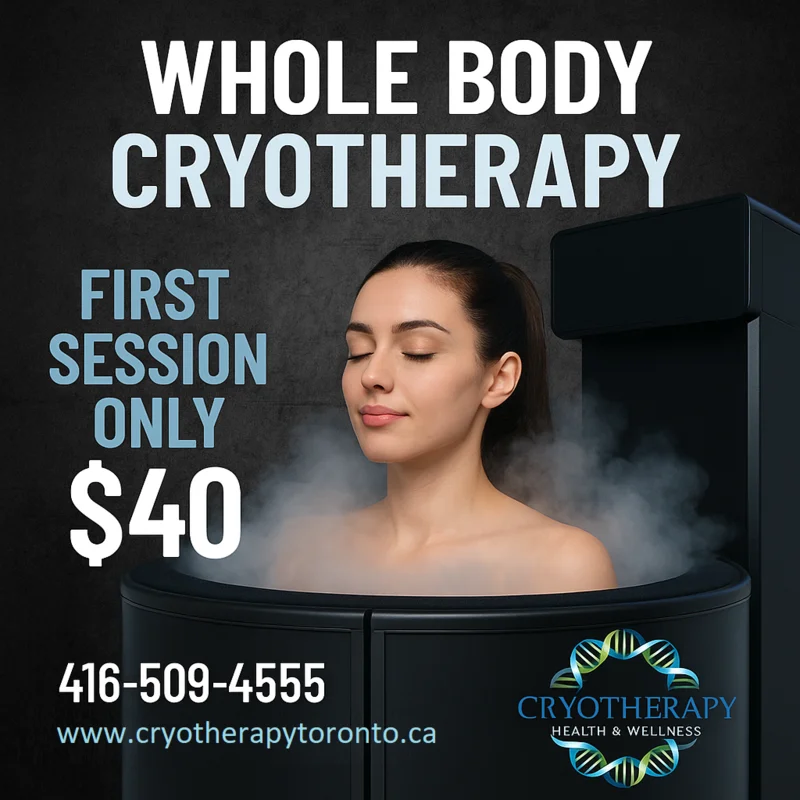
A cryosauna is a single-person, open-top cabin. Liquid nitrogen is vaporised and the cold vapour circulates around your body from the neck down, while your head stays above the rim in ordinary room air. Manufacturers state roughly −110°C to −195°C for these devices, and that's the range we quote for our own cabin.
Why the display number isn't your skin temperature
Any cryo device's temperature describes the cabin air, not you. Body heat warms a thin "boundary layer" of air against your skin. Measurements reported in the 2017 paper, taken with sensors insulated from the skin, put the air right beside the body during nitrogen-cabin sessions at about −25°C to −50°C, far warmer than the stated range. A 2016 technology review also flagged how little published data exists on actual temperatures inside chambers and cabins.
Airflow matters as much as the dial. The same paper reported its −40°C wind chamber cooled average skin temperature by about 11°C in three minutes, more than reported averages for cryosaunas at −140°C to −160°C (its lead author was affiliated with the chamber's developer). Body composition matters too: a 2017 Frontiers in Physiology review highlighted the role of fat mass in how effectively people cool.
How do cryo chambers compare with localized cryotherapy and ice baths?
Temperatures below are what each device or protocol is set to, not skin temperature.
| Method | Temperature | Duration | Head in the cold? | How cooling works | Typical use |
|---|---|---|---|---|---|
| Electric walk-in chamber | Model-dependent; around −110°C is common in research | About 2–4 min | Yes (mask and headband) | Refrigerated, breathable dry air around the whole body | Whole-body recovery; setting for much of the research |
| Nitrogen cryosauna | Stated −110°C to −195°C; air at the skin much warmer | 2–3 min (capped at 3 in our studio) | No, head above the rim | Nitrogen vapour circulates from the neck down | Whole-body recovery and wellness; the format we use |
| Localized cryotherapy | Very cold air aimed at one area | Short, per zone | No | Targeted stream of cold air | One joint or region: knee, shoulder, back, ankle |
| Ice bath | Cold water; protocols vary (8°C in the study below) | Several minutes | Usually no | Water draws heat far faster than air | Post-exercise recovery; low cost, widely studied |
Water conducts heat much better than air; a 2014 review noted that air's poor thermal conductivity prevents significant cooling below the skin and in the core. In a 2012 randomised crossover study of 20 active men, four minutes at −110°C cooled average thigh skin by about 12°C versus about 8°C after four minutes in 8°C water, yet muscle and core temperatures dropped by similar, modest amounts. More in our cryotherapy vs ice bath comparison.
How does whole body cryotherapy work in your body?
The short version: your skin gets very cold, very fast, and your nervous system reacts.
- Rapid skin cooling. Dry, extremely cold air pulls heat from the skin's surface. Deeper tissue and core temperatures change only modestly.
- Blood vessels in the skin narrow. Vasoconstriction is the body's standard defence against cold, redirecting blood toward the core. As you rewarm afterwards, those vessels reopen, which is the warm, tingly flush many people notice.
- A norepinephrine surge. In a 12-week Finnish study, healthy women did two-minute sessions at −110°C three times a week. Plasma norepinephrine (noradrenaline) rose two- to threefold after every session, while epinephrine didn't change (Leppäluoto et al., 2008). The authors suggested this response might play a role in pain relief.
What that study didn't find matters too. Stress hormones ACTH and cortisol weren't stimulated, and the inflammatory cytokines IL-1β, IL-6 and TNF-α didn't change after cold exposure. So "cold switches off inflammation" is more complicated than marketing suggests, at least in healthy people. We also don't lean on "endorphin rush" claims; norepinephrine is the better-documented response.
What are the real cryo chamber benefits? What the evidence says
Muscle soreness and recovery
The 2015 Cochrane review found only four small randomised trials, with 64 mostly young, active participants (all but four male), all at high risk of bias. Evidence was rated very low quality, and the authors concluded there wasn't enough to say whether whole-body cryotherapy reduces soreness or improves recovery compared with rest.
Broader cooling research is more encouraging. A 2015 meta-analysis pooling 27 studies found that cooling, especially cold-water immersion, reduced delayed-onset muscle soreness at 24, 48 and 96 hours versus passive recovery, but had no significant effect on objective measures such as blood markers. The 2014 review found a similar pattern for cryo chambers: small studies suggest people feel less sore and more recovered, with little benefit for functional recovery. See our guide to cryotherapy for DOMS.
Inflammation, pain and stress
The 2014 review found weak evidence that cryo chambers enhance antioxidant capacity, support parasympathetic ("rest and digest") reactivation and alter inflammatory pathways. The 2017 Frontiers review noted that blood biochemistry doesn't always change measurably, yet pain, soreness, stress and recovery were very often improved versus baseline or untreated groups. Promising, not proof.
Sleep and mood
The 2023 consortium review lists improved sleep quality, faster recovery after high-intensity exercise and chronic pain relief among reported effects, plus some evidence on mood. It focused on walk-in chambers, so those findings don't automatically transfer to nitrogen cabins.
Our position after 13 years: cryotherapy is a recovery and wellness tool many people find worthwhile, not a medical treatment. If you have a diagnosed condition, talk to your physician and use it alongside your care, not instead of it. More on whole body cryotherapy benefits.
Is a cryo chamber safe? How the two types differ
Safety data is thinner than it should be: none of the Cochrane trials actively monitored adverse events. The 2023 safety review of walk-in chambers found 16 documented adverse events and concluded the risks are within acceptable limits and preventable by following existing recommendations, contraindications and common-sense guidelines. Its authors note that concerns raised by health authorities such as the US FDA drew partly on reports from nitrogen cabins, a format with its own risk to manage.
Nitrogen cryosaunas: the breathing risk
Nitrogen isn't poisonous; it makes up most of the air we breathe. But concentrated nitrogen vapour displaces oxygen, and breathing it can cause dizziness or loss of consciousness with little warning. That's why, in our studio, your head stays above the cabin at all times so you never breathe the vapour, and a trained technician is present for every session.
Electric chambers: the cold reaches your head
Walk-in chambers don't put nitrogen in your breathing air, but your face, ears and airways are exposed to extreme cold, which is why participants in the 2017 chamber study wore a headband and surgical mask.
Risks common to both
- Wet skin. Sweat, water, lotion or damp fabric can freeze against the skin and raise the risk of cold burns or frostbite. That's why we insist your skin is completely dry.
- Over-exposure. Longer isn't better. Our sessions run two to three minutes, capped at three.
- Extremities. We provide thermal gloves, socks, slippers and ear protection.
- Underlying conditions. Uncontrolled high blood pressure, a recent heart attack, Raynaud's, cold allergy, seizure disorders and pregnancy are among the conditions on our contraindications list.
For more, read our cryotherapy side effects and safety guide.
What is a cryosauna session like at our Toronto studio?
Here's how a whole body cryotherapy session runs at our North York studio.
- Free consultation. Plan about 30 minutes for your first visit. A technician reviews your health history, goals and contraindications one-on-one and builds a personalised plan.
- Change. Underwear, plus a sports bra for women. We provide thermal gloves, socks, slippers and ear protection. Your skin must be completely dry.
- Step in. Your head stays above the rim of the open-top cabin the whole time, breathing normal room air.
- Two to three minutes. The cabin runs between −110°C and −195°C. Expect an intense, dry cold rather than the heavy ache of an ice bath. Your technician is with you throughout, and sessions are capped at three minutes.
- Step out and rewarm. Here's what to expect after cryotherapy.
Some people feel relief after one session; for chronic issues or athletic goals, most see their best results with two to three sessions per week, and your technician will recommend a schedule. A first-time trial is $40, a single session $60, and the 10-session pack ($500) is our most popular option, plus HST. Packages never expire. See pricing.
Electric chamber or nitrogen cryosauna: which should you choose?
- Want conditions closest to "true" whole-body research? A walk-in electric chamber is the nearer match.
- Prefer to keep extreme cold off your face and airways? An open-top cryosauna keeps your head in room air.
- Only one area bothers you? Localized cryotherapy targets a knee, shoulder or lower back directly, at $45 a session.
- Cost is the deciding factor? The 2014 review concluded that cheaper options such as ice packs and cold-water immersion offer comparable physiological and clinical effects.
- Mildly claustrophobic? An open-top cabin may feel easier than a closed room, though severe claustrophobia is a contraindication.
Our clients range from MMA fighters and hockey players to runners, office workers and retirees; the right format is the one that fits your body, goals and budget.
How do you choose a cryotherapy provider in Toronto?
Whatever the equipment, ask before you book:
- Is a trained technician present for the entire session?
- Do you review my health history and contraindications first?
- What's the maximum exposure time?
- For nitrogen cabins: does my head stay above the rim, and how is the room ventilated?
- Do you provide gloves, socks and slippers, and check that my skin is dry?
- How do you describe the evidence? Promises of cures, "detox" or dramatic weight loss are a red flag.
- How long have you operated, and what do your Google reviews say?
Our answers: a technician at every session, a free consultation for every new client, a three-minute cap and your head always above the cabin. We've operated since 2013 as one of Ontario's first dedicated cryotherapy centres, with 15,000+ sessions delivered and a 5.0★ Google rating from 135+ reviews. Get in touch or call (416) 509-4555.
Frequently asked questions
Is a cryo chamber the same as a cryosauna?
How cold is a cryo chamber?
Do you breathe nitrogen in a cryosauna?
How long do you stay in a cryotherapy chamber?
Is a cryo chamber better than an ice bath?
What should I wear for whole body cryotherapy?
Who should not use a cryo chamber?
Sources & further reading
- Costello JT, Baker PR, Minett GM, et al. Whole-body cryotherapy (extreme cold air exposure) for preventing and treating muscle soreness after exercise in adults. Cochrane Database Syst Rev. 2015;(9):CD010789. pubmed.ncbi.nlm.nih.gov/26383887/
- Bouzigon R, Grappe F, Ravier G, Dugue B. Whole- and partial-body cryostimulation/cryotherapy: Current technologies and practical applications. J Therm Biol. 2016;61:67-81. pubmed.ncbi.nlm.nih.gov/27712663/
- Bouzigon R, Arfaoui A, Grappe F, et al. Validation of a new whole-body cryotherapy chamber based on forced convection. J Therm Biol. 2017;65:138-144. pubmed.ncbi.nlm.nih.gov/28343567/
- Legrand FD, Dugué B, Costello J, et al. Evaluating safety risks of whole-body cryotherapy/cryostimulation (WBC): a scoping review from an international consortium. Eur J Med Res. 2023;28(1):387. pubmed.ncbi.nlm.nih.gov/37770960/
- Costello JT, Culligan K, Selfe J, Donnelly AE. Muscle, skin and core temperature after −110°C cold air and 8°C water treatment. PLoS One. 2012;7(11):e48190. pubmed.ncbi.nlm.nih.gov/23139763/
- Bleakley CM, Bieuzen F, Davison GW, Costello JT. Whole-body cryotherapy: empirical evidence and theoretical perspectives. Open Access J Sports Med. 2014;5:25-36. pubmed.ncbi.nlm.nih.gov/24648779/
- Leppäluoto J, Westerlund T, Huttunen P, et al. Effects of long-term whole-body cold exposures on plasma concentrations of ACTH, beta-endorphin, cortisol, catecholamines and cytokines in healthy females. Scand J Clin Lab Invest. 2008;68(2):145-153. pubmed.ncbi.nlm.nih.gov/18382932/
- Hohenauer E, Taeymans J, Baeyens JP, et al. The effect of post-exercise cryotherapy on recovery characteristics: a systematic review and meta-analysis. PLoS One. 2015;10(9):e0139028. pubmed.ncbi.nlm.nih.gov/26413718/
- Lombardi G, Ziemann E, Banfi G. Whole-body cryotherapy in athletes: from therapy to stimulation. An updated review of the literature. Front Physiol. 2017;8:258. pubmed.ncbi.nlm.nih.gov/28512432/
Try cryotherapy in Toronto
New clients start with a $40 first visit including a free one-on-one consultation. 4646 Dufferin St, North York · Since 2013 · 15,000+ sessions · 5.0★ from 135+ Google reviews.