A practitioner's guide to targeted cold for one sore joint or muscle: what it can and cannot do, how it compares with an ice pack and whole body cryotherapy, and what a session at our North York studio involves.
Key takeaways
- Localized cryotherapy directs very cold, dry air at one area, such as a knee, shoulder or elbow, to ease pain and swelling for a short time.
- Cold narrows blood vessels and slows nerve signals, but most trials are small and low quality; the strongest signal is as an add-on for rheumatoid arthritis pain.
- Whether it beats an ice pack depends on the device: in one knee study, nitrogen vapour cooled skin more than an ice bag and cold air cooled it less.
- For chronic issues we usually suggest 2–3 sessions a week, paired with the exercise plan from your physiotherapist or doctor.
- In our North York studio, localized sessions cost $35 for an intro visit and $45 for a single, plus HST; packages never expire.
What is localized cryotherapy?
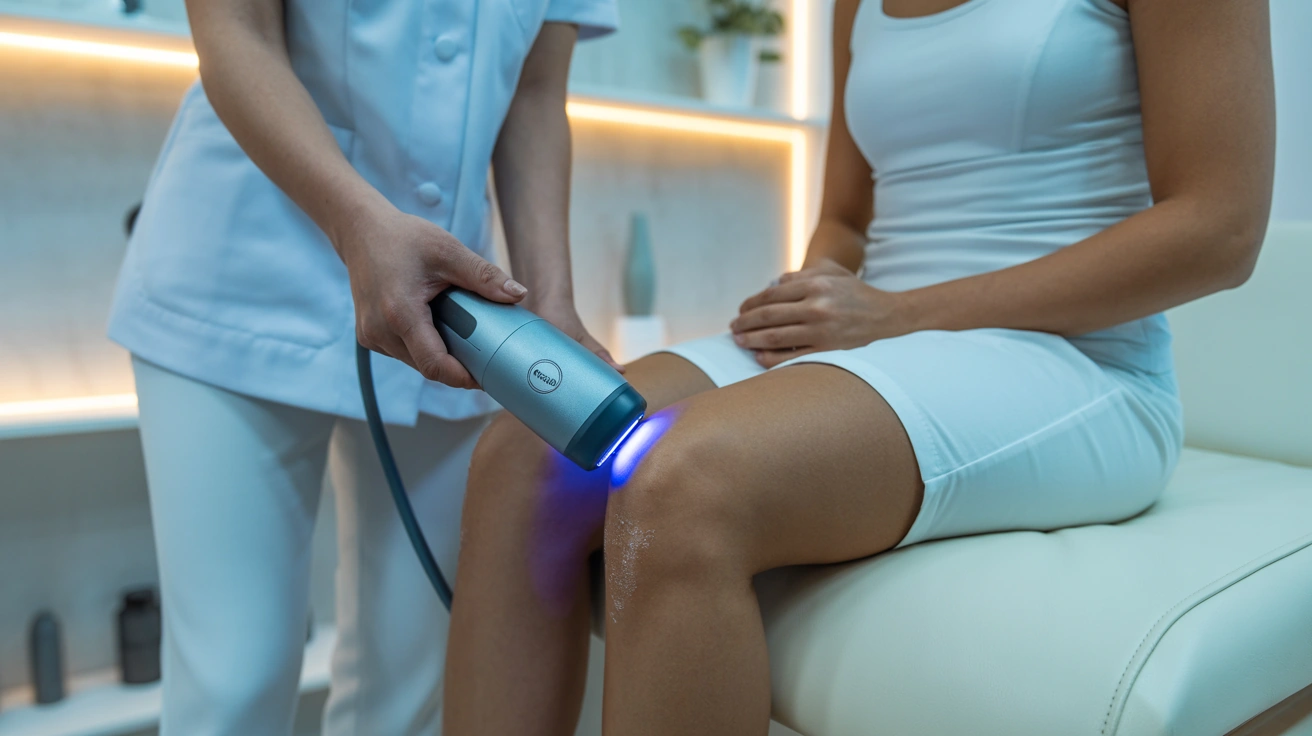
Quick answer: Localized cryotherapy is a short, targeted cold therapy in which a device directs very cold, dry air onto one area, such as a knee, shoulder, elbow or the lower back. Research suggests cold may ease pain and swelling for a short time, but the evidence varies by condition and is often low quality.
You will also see it called local, targeted or spot cryotherapy. The idea is the same: cool one problem area quickly, without chilling the whole body.
We opened Cryotherapy Toronto in 2013 as one of Ontario's first dedicated cryotherapy centres. Our clients range from runners and hockey players to office workers with back pain and retirees with stiff joints. This guide is what we tell them, including where the evidence is thin.
What kinds of devices are used?
Clinics and research labs mainly use two types: units that release liquid-nitrogen vapour and units that blow refrigerated cold air. In one randomised trial in rheumatoid arthritis, the local cold-air device ran at −30°C. Ice bags and gel packs are the low-tech version of the same idea. Device type changes how much the skin actually cools, as the comparison below shows.
In our studio, each session covers one focused zone: knees, shoulders, back, elbows, hips, neck, wrists or ankles. Details are on our page for localized cryotherapy in Toronto.
How does localized cryotherapy work on pain and swelling?
Cold acts on pain and swelling in a few overlapping ways. A 2015 review of heat and cold therapies lists the physiological effects of cold as reductions in pain, blood flow, swelling, inflammation, muscle spasm and metabolic demand.
- Vasoconstriction: blood vessels in the cooled area narrow, reducing blood flow and possibly fluid build-up after an injury.
- Slower nerve signals: in a 2007 study of 23 male athletes, cooling ankle skin to 10°C slowed nerve conduction by about a third, while pain threshold and pain tolerance rose.
- Lower local metabolism: cooled tissue has lower metabolic demand, the reasoning behind using cold early after an injury.
The catch is that these effects are short-lived. In a 2021 thermal-imaging study of the knee in 23 healthy adults, significant skin cooling lasted up to about 15 minutes after three minutes of nitrogen vapour, 10 minutes after an ice bag and 5 minutes after cold air.
That is why we describe localized cryotherapy as a way to take the edge off pain so you can move and do your rehab, not as a fix for the underlying problem.
Does localized cryotherapy work? The evidence by condition
The honest summary: cold reliably feels good for a while, but good-quality trials are scarce, and few test localized cold-air devices. Here is how we rate the research.
| Condition | What the research shows | Our honest rating |
|---|---|---|
| Acute sprains and strains | A 2004 systematic review of 22 trials found low study quality and only marginal evidence that ice plus exercise works best after ankle sprain and surgery. No optimal method or duration emerged. | Limited: reasonable for short-term relief |
| Post-exercise muscle soreness | The 2015 review found limited trial evidence for cold, and notes trials where a heat wrap relieved delayed-onset soreness more than cold. | Limited |
| Knee osteoarthritis pain | A 2019 systematic review found only five trials (202 people) and low-level evidence; no firm conclusions were possible. | Uncertain |
| Rheumatoid arthritis flares | A 2014 systematic review pooled six studies (257 people) and found lower pain and disease-activity scores with repeated cryotherapy. In a 2006 trial, pain fell with local cold air and cold packs as well as whole body cryotherapy. | Most promising, as an add-on to medical care |
| Tennis elbow and other tendinopathies | No good-quality trials of localized cold air alone that we are aware of. | Not established |
| Plantar heel pain (plantar fasciitis) | Likewise, no strong trials of localized cold alone that we can point to. | Not established |
| Swelling after knee replacement | A 2025 Cochrane review (22 trials, 1,839 people, mostly ice or cooled-water devices) found low-certainty evidence that cold may slightly reduce pain at 48 hours and early swelling, with no difference at six weeks. The authors said the benefits may be too small to justify its use. | Low certainty: follow your surgeon's plan |
One caveat: the rheumatoid arthritis trial added cold to physiotherapy and had no no-cold group, so not all of the improvement can be credited to cold.
What about back, neck and shoulder pain?
These are among the most common reasons people come to us, yet we have not found strong trials of localized cold air for chronic back, neck or shoulder pain specifically. A 2021 narrative review of 25 chronic-pain studies concluded that local and whole body cold show promise for chronic pain of rheumatic and degenerative origin and can be low-risk in carefully selected patients, but long-term effects need more study.
So we frame localized sessions as one tool for comfort and mobility, alongside the exercise plan from your physiotherapist or doctor. For condition-specific guidance, see our pages on knee injuries, repetitive strain injuries such as tennis elbow, and cryotherapy for arthritis and chronic pain.
Localized cryotherapy vs ice packs vs whole body cryotherapy: which is better?
The right choice depends mostly on whether your problem sits in one joint or across the whole body.
| Ice or gel pack | Localized cryotherapy | Whole body cryotherapy | |
|---|---|---|---|
| What is cooled | One area | One focused zone | The body from the neck down; your head stays above the cabin |
| Cold source | Ice or frozen gel | Very cold, dry air or nitrogen vapour aimed at the area | Nitrogen vapour in an open-top cryosauna, −110°C to −195°C (our studio) |
| Session length | Up to you, so easy to overdo or underdo | Quick | 2–3 minutes, capped at 3 |
| Wet or dry | Can get wet as ice melts | Dry | Dry; skin must be dry before you enter |
| Skin cooling after 3 minutes (2021 knee study) | About 7.6°C drop | About 10°C drop (nitrogen vapour) or 6.8°C (cold air) | Not measured in that study |
| Supervision | None | In studio, after a consultation | Trained technician present for every session |
| Price | A few dollars, reusable | $35 intro, $45 single (+HST) | $40 first-time trial, $60 single (+HST) |
| Best fit | Home care between visits | One sore joint or muscle | Widespread soreness or whole-body recovery goals |
Localized cryotherapy vs an ice pack
An ice pack is cheap and useful at home, and most cold-therapy research actually uses ice packs. Whether a studio device cools better depends on the device. What a studio session adds is a dry, quick, consistent dose after screening for reasons cold may not suit you.
Localized vs whole body cryotherapy
In the 2006 rheumatoid arthritis trial, pain fell most in the −110°C whole body group, yet the authors concluded whole body cryotherapy was not superior to local cryotherapy for pain relief as an add-on to physiotherapy. Our rule of thumb: one problem joint, start local; widespread aches or full-body recovery goals, consider whole body cryotherapy.
What happens during a localized cryotherapy session at our North York studio?
- Free consultation. Your first visit includes a one-on-one consultation: we review your health history and goals and build a personalised plan. Plan for about 30 minutes.
- Contraindication check. We review contraindications with every new client. Mention any numbness in the area, circulation problems or recent surgery.
- One focused zone. Cold, dry air is directed at your chosen zone. Nearby related areas are often included; a separate region, such as a knee and a shoulder, may cost extra. As with whole body sessions, skin must be dry.
- Back to your day. Sessions are quick, with no downtime.
Expect intense cold, often followed by tingling, and some pinkness as the area rewarms. Tell us straight away if it becomes painful or you lose feeling.
We are at 4646 Dufferin St, Unit 3, Suite 23, North York, and see clients from across Toronto and the GTA. Since 2013 we have delivered more than 15,000 sessions. To book a consultation, call (416) 509-4555 or contact our team.
How often should you do localized cryotherapy, and how many sessions?
Some people feel relief after a single session. For chronic issues, most clients see the best results with 2–3 sessions per week, and your technician will recommend a schedule.
Acute injury vs chronic pain
- Acute (a fresh sprain or strain): get a significant injury assessed first (see the red flags below). Cold is a reasonable comfort measure early on, and the 2004 review found ice combined with exercise looked best.
- Chronic (arthritis, a long-running tendon or back problem): consistency matters more than intensity. A regular rhythm of 2–3 sessions a week, reviewed with your technician, makes more sense than occasional one-offs.
Research has not settled the ideal dose. The 2004 review found no evidence of an optimal method or duration, and the 2019 knee osteoarthritis review found technique, frequency and duration did not affect outcomes.
How to tell if it is working
- Rate your pain from 0 to 10 before and after sessions, and the next morning.
- Track one task you care about: stairs, sleep, reaching overhead or your usual run.
- If nothing has changed after a fair trial, tell your technician and your doctor.
Is localized cryotherapy safe, and who should avoid it?
Localized cryotherapy cools a small area rather than the whole body, but extreme cold on skin still carries real risks, including cold burns. The 2021 chronic-pain review called cryotherapy low-risk in carefully selected patients, and the 2025 Cochrane review listed discomfort, skin reactions and cold-induced injuries among reported adverse events. Selection is the key word.
Cryotherapy is not suitable if you have any condition on our contraindications list. The ones most relevant to localized sessions include:
- Raynaud's phenomenon, cold urticaria (cold allergy) or cryoglobulinemia
- Peripheral arterial occlusive disease, circulatory dysfunction, vasculitis, DVT or a clotting disorder
- Previous frostbite in the area to be cooled
- Open wounds, a skin infection or an unhealed incision in the area
- Sickle cell anemia, severe anemia, uncontrolled high blood pressure or a heart attack in the past six months
- Pregnancy
The full list is on our contraindications page. Also tell us about reduced feeling in the area, for example from diabetes-related nerve damage, because you may not notice if the cold becomes too much.
Check your skin afterwards
Pinkness and tingling that fade as the skin rewarms are expected. Blisters, white or greyish waxy patches, or numbness that lingers are not, and need medical attention. See our guide to cryotherapy side effects and safety.
How much does localized cryotherapy cost in Toronto?
Our localized pricing, in Canadian dollars plus 13% HST:
| Option | Price | Per session |
|---|---|---|
| Intro session | $35 | $35 |
| Single session | $45 | $45 |
| 5 sessions | $200 | $40 |
| 10 sessions | $380 | $38 |
| 15 sessions | $525 | $35 |
| Bundle & Save add-on to a whole body visit | From $30 | From $30 |
Packages never expire and are tied to the purchaser, so they cannot be shared.
Example: two sessions a week for five weeks is 10 sessions. As singles that costs $508.50 with HST; as a 10-pack, $429.40.
See our full pricing, our breakdown of cryotherapy costs in Toronto, or the service page for localized cryotherapy in Toronto.
When should you see a doctor or physiotherapist instead?
Localized cryotherapy is a comfort and recovery tool, not a diagnosis. See a physician, physiotherapist or urgent care first if:
- You cannot bear weight, or a joint looks deformed after a fall or twist.
- A joint is hot, red and swollen and you feel unwell or feverish.
- A calf is swollen, warm and tender, which can signal a blood clot.
- Numbness, tingling or weakness spreads down an arm or leg.
- Back pain comes with bladder or bowel changes or numbness around the groin. Go to an emergency department.
- Pain wakes you at night or is not improving after a few weeks.
Once you have a diagnosis, localized sessions can sit alongside your rehab. Bring your questions to a free consultation and we will tell you honestly whether localized cryotherapy in our Toronto studio fits your plan.
Frequently asked questions
Is localized cryotherapy better than an ice pack?
Does localized cryotherapy hurt?
Can localized cryotherapy help knee pain?
How long does the relief from localized cryotherapy last?
Can I combine localized and whole body cryotherapy in one visit?
Is localized cryotherapy safe after surgery?
Sources & further reading
- Bleakley C, McDonough S, MacAuley D. The use of ice in the treatment of acute soft-tissue injury: a systematic review of randomized controlled trials. Am J Sports Med. 2004;32(1):251-61. pubmed.ncbi.nlm.nih.gov/14754753/
- Malanga GA, Yan N, Stark J. Mechanisms and efficacy of heat and cold therapies for musculoskeletal injury. Postgrad Med. 2015;127(1):57-65. pubmed.ncbi.nlm.nih.gov/25526231/
- Algafly AA, George KP. The effect of cryotherapy on nerve conduction velocity, pain threshold and pain tolerance. Br J Sports Med. 2007;41(6):365-9. pubmed.ncbi.nlm.nih.gov/17224445/
- Radecka A, Pluta W, Lubkowska A. Assessment of the Dynamics of Temperature Changes in the Knee Joint Area in Response to Selected Cooling Agents in Thermographic Tests. Int J Environ Res Public Health. 2021;18(10):5326. pubmed.ncbi.nlm.nih.gov/34067781/
- Dantas LO, Moreira RFC, Norde FM, Mendes Silva Serrao PR, Alburquerque-Sendín F, Salvini TF. The effects of cryotherapy on pain and function in individuals with knee osteoarthritis: a systematic review of randomized controlled trials. Clin Rehabil. 2019;33(8):1310-1319. pubmed.ncbi.nlm.nih.gov/30957514/
- Guillot X, Tordi N, Mourot L, Demougeot C, Dugué B, Prati C, et al. Cryotherapy in inflammatory rheumatic diseases: a systematic review. Expert Rev Clin Immunol. 2014;10(2):281-94. pubmed.ncbi.nlm.nih.gov/24345205/
- Hirvonen HE, Mikkelsson MK, Kautiainen H, Pohjolainen TH, Leirisalo-Repo M. Effectiveness of different cryotherapies on pain and disease activity in active rheumatoid arthritis. A randomised single blinded controlled trial. Clin Exp Rheumatol. 2006;24(3):295-301. pubmed.ncbi.nlm.nih.gov/16870097/
- Garcia C, Karri J, Zacharias NA, Abd-Elsayed A. Use of Cryotherapy for Managing Chronic Pain: An Evidence-Based Narrative. Pain Ther. 2021;10(1):81-100. pubmed.ncbi.nlm.nih.gov/33315183/
- Aggarwal A, Adie S, Harris IA, Naylor J. Cryotherapy following total knee replacement. Cochrane Database Syst Rev. 2025;10(10):CD007911. pubmed.ncbi.nlm.nih.gov/41165130/
Try cryotherapy in Toronto
New clients start with a $40 first visit including a free one-on-one consultation. 4646 Dufferin St, North York · Since 2013 · 15,000+ sessions · 5.0★ from 135+ Google reviews.