
Research suggests cryotherapy may ease knee arthritis pain and swelling for a while, but it is no substitute for exercise and cannot rebuild cartilage. Here is what the trials show, how localized cryotherapy compares with an ice pack, and what a first knee session at our North York studio involves.
Key takeaways
- Research suggests cryotherapy may modestly ease knee osteoarthritis pain and swelling in the short term; a 2025 meta-analysis of five trials found lower pain scores and saw cold as most useful alongside exercise.
- Two sham-controlled Brazilian trials found cold added no meaningful benefit, and no study shows it rebuilds cartilage or slows OA.
- Ice remains a sensible home option: in one arthritic-knee study, nitrogen cold air cooled the skin more, but ice cooled the joint more.
- Exercise, weight loss for people who are overweight, and medical care come first; the ACR guideline gives heat and cold only a conditional recommendation.
- At our North York studio, localized knee sessions are $35 intro and $45 single plus HST, and for chronic issues most clients see the best results with 2–3 sessions a week.
Does cryotherapy help knee arthritis?
Quick answer: Cryotherapy may ease knee arthritis pain and swelling for a short time, but the evidence is modest. A 2025 meta-analysis of five trials found lower pain scores and suggested cold may be most useful within an exercise-based plan, while two sham-controlled trials found no meaningful extra benefit. It cannot rebuild cartilage or replace exercise.
Since 2013, our North York studio has delivered more than 15,000 supervised sessions, from runners and hockey players to retirees seeking drug-free joint relief. Here is what the knee trials found, how studio cryotherapy for knee pain compares with ice, and where it fits next to exercise and medical care.
Cryotherapy is a wellness service, not a treatment for the disease itself. If you're comparing knee arthritis treatment in Toronto and your knee hasn't been assessed, start with your family doctor or a physiotherapist. Our knee injury and knee pain page lists the warning signs that need medical care first.
What does the research say about cryotherapy for knee osteoarthritis?
We checked every study below against its PubMed record in October 2026. Most were small, and several used ice rather than studio devices.
| Study | Who and what | Main finding | Limits |
|---|---|---|---|
| Dias et al., 2025 (systematic review and meta-analysis) | 5 randomised trials in knee osteoarthritis (OA) | Pooled pain scores favoured cryotherapy; function did not improve significantly. Authors: may be useful within a wider plan, especially with exercise therapy. | Stand-alone benefit needs better-quality trials |
| Brosseau et al., 2003 (Cochrane review, University of Ottawa) | 3 trials, 179 people; ice massage, cold packs and hot packs | Ice massage (20 minutes, 5 days a week for 3 weeks) improved quadriceps strength, with small gains in knee bend and function. Cold packs reduced swelling. Ice packs did not significantly change pain. | Few, varied trials of mixed quality |
| Dantas et al., 2019 (randomised trial, Brazil) | 60 people; crushed-ice packs with mild compression daily for 4 days, versus sand-filled sham packs | Not superior to sham: pain fell 0.8 cm more on a 10 cm scale, short of the 1.75 cm judged worthwhile | Very short course |
| Perea et al., 2026 (randomised trial, Brazil) | 120 people; 8 weeks of exercise (24 sessions) alone, with cryotherapy or with sham cryotherapy | Exercise helped; adding cryotherapy made no difference to resting pain after treatment or at follow-up | Tested cold as an add-on, not on its own |
| Guillot et al., 2017 (randomised trial, France) | 30 people with non-septic knee arthritis; ice for 30 minutes or cold CO2 for 2 minutes, applied twice, 8 hours apart | Both reduced pain and power Doppler activity (an ultrasound sign of joint inflammation) over 24 hours. No adverse events were reported. | Not limited to OA; one day only |
| Chruściak, 2016 (questionnaire study, Poland) | 50 people with OA (only 10 with knee OA); a 10-day whole body cryotherapy course | 78% reported significant improvement, and the author reported less painkiller use | No control group; self-reported |
The pattern: cold may take the edge off knee pain or swelling for a while, but against a convincing sham, or on top of a good exercise program, the extra benefit shrinks or disappears.
What about whole body cryotherapy for knee OA?
As of October 2026, we found no randomised trial of whole body cryotherapy specifically for knee OA on PubMed. The uncontrolled Polish study can't separate the effect of cold from expectation. If several joints ache, not just one knee, our guide to cryotherapy for arthritis and chronic pain explains when whole body cryotherapy may be the better fit.
What can cryotherapy help with, and what can't it do?
Where it may help
- Short-term pain. The 2025 meta-analysis found lower pain scores overall, though the two Brazilian sham-controlled trials did not.
- Swelling. In the Cochrane review, cold packs reduced knee swelling.
- Strength and movement. In one trial, ice massage improved quadriceps strength, with small but statistically significant changes in knee bend and function.
Cold therapy for knee arthritis may work partly by cooling the joint itself. In a 1994 Dutch study of arthritic knees, ice chips and nitrogen cold air both lowered the temperature inside the joint, not just on the skin.
What it can't do
- Rebuild cartilage or reverse joint changes. None of the knee OA trials above measured cartilage or joint structure, and none suggests cold alters the course of the disease.
- Replace exercise, weight management or medical care, which have stronger guideline support.
- Promise lasting relief. Most trials were short, and none showed lasting benefit from cold on its own.
Ice vs cryotherapy for knee pain: is localized cryotherapy better?
Not necessarily. Much of the knee OA evidence comes from ice, which is cheap and easy to use at home. In the 1994 Dutch study of 39 people with arthritic knees, nitrogen cold air cooled the skin more, but ice chips cooled the inside of the joint more.
| Ice pack or ice massage | Localized cryotherapy | Whole body cryotherapy | |
|---|---|---|---|
| What is cooled | The knee you apply it to | One focused zone, such as a knee | The body from the neck down; your head stays above the cabin |
| Cold source | Ice, crushed ice or a gel pack | Targeted, very cold, dry air | Nitrogen vapour, −110°C to −195°C (our studio) |
| Time | 20 or 30 minutes in two trials above | Quick, no downtime | 2–3 minutes, capped at 3 |
| Cooling in the 1994 arthritic-knee study | Ice chips: skin 32.2°C to 16.0°C; inside the joint 35.5°C to 29.1°C | Nitrogen cold air: skin 32.6°C to 9.8°C; inside the joint 35.8°C to 32.5°C | Not measured |
| Knee OA evidence | Most of the trials; mixed results | Very few trials in knee arthritis | No randomised knee OA trials found |
| Cost (+13% HST) | A few dollars | $35 intro, $45 single | $40 first-time trial, $60 single |
| Best fit | Home use between visits | One sore knee | Several aching joints |
Devices vary, so those temperatures won't map exactly onto our equipment. In the 2017 French trial, 30 minutes of ice and 2 minutes of cold CO2 eased knee pain equally. What a localized cryotherapy session in Toronto adds is a quick, dry, consistent dose after a free consultation; our localized cryotherapy guide covers devices.
How does cryotherapy fit with exercise, physio and weight management?
The 2019 American College of Rheumatology/Arthritis Foundation guideline for hand, hip and knee OA, whose authors include a University of Toronto researcher, made strong recommendations for:
- Exercise
- Weight loss for people with knee or hip OA who are overweight or obese
- Self-efficacy and self-management programs, and tai chi
- Cane use and tibiofemoral knee bracing
- Anti-inflammatory medicines (NSAIDs) and steroid injections for knee OA, decisions for you and your doctor
Thermal modalities (heat and cold treatments) received only a conditional recommendation. The 2026 Brazilian trial points the same way: exercise helped, and cryotherapy added nothing measurable. The 2025 meta-analysis was more positive about cold with exercise, so the fair reading is that cryotherapy, if it helps you, plays a supporting role.
Practical ways to combine them
- Keep your strengthening program as the priority; don't swap physio for cryotherapy.
- Localized sessions have no downtime, so one can fit on a physio day; ask your physiotherapist about timing.
- Change one thing at a time so you can tell what is helping.
- Never stop or change prescribed medication without speaking to your doctor.
Can you use cryotherapy after a knee replacement?
Total knee replacement is a common operation for end-stage knee OA. A 2025 Cochrane review of 22 trials (1,839 people) looked at cold applied with ice or cooled water, often through specialised devices, within 48 hours of surgery. It found low-certainty evidence that cryotherapy may:
- Reduce blood loss (about 561 mL versus 825 mL)
- Slightly reduce pain at 48 hours (about 3.2 versus 4.8 on a 0–10 scale)
- Improve knee bend at discharge by about 8 degrees
- Reduce swelling two to six days after surgery, though not at six weeks or three months
The authors were uncertain about function and adverse events, which included discomfort, skin reactions and cold-induced injuries, and concluded the benefits may be too small to justify its use.
Those trials studied hospital care, not studio sessions, so follow your surgical team's rehab plan. Book a localized session only with your surgeon's go-ahead and once the incision has fully healed, because open wounds are a contraindication.
Who should avoid cryotherapy for knee arthritis?
Knee OA itself is not a reason to avoid cold, but other conditions can be. Our full contraindications list includes:
- Peripheral arterial disease, DVT, circulatory or clotting disorders, or vasculitis
- Raynaud's, cold urticaria (cold allergy), cryoglobulinemia or prior frostbite
- Uncontrolled high blood pressure, a recent heart attack, heart failure, unstable angina, valve disease, a pacemaker or recent heart surgery
- Open wounds, including an unhealed surgical incision
- Sickle cell disease or severe anemia
- Pregnancy
Also tell us if the skin around your knee has reduced feeling, for example from diabetes-related nerve damage, because you may not notice if the cold becomes too much. Pinkness and tingling that fade as the skin rewarms are expected; blisters or pale, waxy patches are not, and need medical attention. See our cryotherapy side effects and safety guide.
See a doctor first if
- Your knee is suddenly hot, red and swollen, or you feel feverish or unwell
- You can't bear weight, or the knee locks or gives way
- Your calf is swollen, warm or tender, which can signal a blood clot
- Pain wakes you at night or keeps worsening
How many sessions do people book, and what does it cost in Toronto?
Some people feel relief after one session. For chronic issues like knee OA, most clients see the best results with 2–3 sessions per week, and your technician will recommend a schedule. Research hasn't settled the ideal dose: trial schedules ranged from four days in a row to three times a week for eight weeks. See our guide to how often to do cryotherapy.
Localized cryotherapy prices (CAD, plus 13% HST)
| Option | Price | Per session |
|---|---|---|
| Intro session | $35 | $35 |
| Single session | $45 | $45 |
| 5 sessions | $200 | $40 |
| 10 sessions | $380 | $38 |
| 15 sessions | $525 | $35 |
| Bundle & Save add-on to a whole body visit | From $30 | From $30 |
Packages never expire and are tied to the purchaser. For example, five sessions over about two weeks cost $226.00 with HST as a 5-pack, versus $254.25 as singles. Full rates are on our pricing page.
How to tell if it's working
- Before starting, rate your knee pain from 0 to 10 and note how long morning stiffness lasts.
- Track one task you care about, such as stairs, getting out of a chair or the walk to your TTC stop.
- After a few weeks, review your notes with your technician and physio. No change? It's reasonable to stop.
What happens at a first localized cryotherapy knee session in North York?
- Book. Call (416) 509-4555 or contact our team. We're open Monday to Friday 9am–6pm and Saturday 10am–4pm (by appointment).
- Free consultation. Plan about 30 minutes for your first visit. We review your health history, goals and contraindications one-on-one, then build a personalised plan. Bring your diagnosis details, surgery dates and medication list.
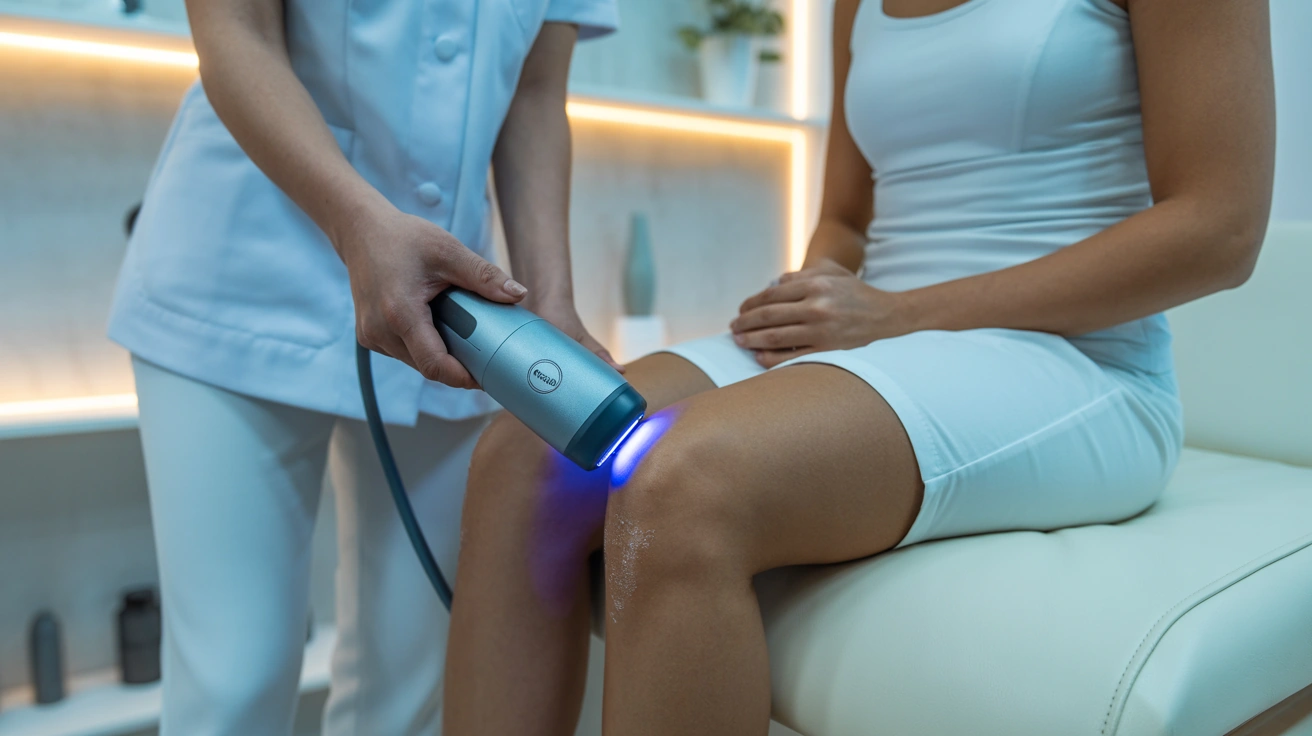
- The cold. Targeted cold air is directed at your knee. Nearby related areas are often included, while a separate region may cost extra, so ask whether your other knee counts as its own zone. Wear shorts or loose trousers you can roll above the knee. Expect intense cold and tingling, and tell us straight away if it becomes painful or numb.
- Back to your day. There is no downtime, so you can carry on with your plans.
We're at 4646 Dufferin St, Unit 3, Suite 23, North York, just south of Finch Avenue West and about 2 km north of Highway 401 at the Dufferin Street exit. TTC buses run along Dufferin Street and Finch Avenue West.
Frequently asked questions
Is cryotherapy good for arthritis in the knees?
Is ice or cryotherapy better for knee pain?
Can cryotherapy regrow cartilage or reverse knee arthritis?
Should I choose whole body or localized cryotherapy for knee arthritis?
Can I have cryotherapy after a knee replacement?
How much does localized cryotherapy for knees cost in Toronto?
Sources & further reading
- Dias RF, de Lima Silva S, de Mello SP, Flores LJF, Buzanello MR, Bertolini GRF. Cryotherapy in knee osteoarthritis: a systematic review with meta-analysis. Pain Pract. 2025;25(6):e70055. pubmed.ncbi.nlm.nih.gov/40521698/
- Brosseau L, Yonge KA, Robinson V, Marchand S, Judd M, Wells G, Tugwell P. Thermotherapy for treatment of osteoarthritis. Cochrane Database Syst Rev. 2003;(4):CD004522. pubmed.ncbi.nlm.nih.gov/14584019/
- Dantas LO, Breda CC, da Silva Serrao PRM, Aburquerque-Sendín F, Serafim Jorge AE, Cunha JE, Barbosa GM, Durigan JLQ, Salvini TF. Short-term cryotherapy did not substantially reduce pain and had unclear effects on physical function and quality of life in people with knee osteoarthritis: a randomised trial. J Physiother. 2019;65(4):215-221. pubmed.ncbi.nlm.nih.gov/31521551/
- Perea J, Viana Ferrari A, Almeida Silva HJ, Serafim Jorge AE, Ogura Dantas L, Mattos Ferreti G, et al. Does cryotherapy associated with physical exercise add benefits to pain, function and quality of life in knee osteoarthritis? A randomized controlled trial. Braz J Phys Ther. 2026;30(3):101594. pubmed.ncbi.nlm.nih.gov/41819673/
- Guillot X, Tordi N, Prati C, Verhoeven F, Pazart L, Wendling D. Cryotherapy decreases synovial Doppler activity and pain in knee arthritis: a randomized-controlled trial. Joint Bone Spine. 2017;84(4):477-483. pubmed.ncbi.nlm.nih.gov/27825572/
- Oosterveld FG, Rasker JJ. Effects of local heat and cold treatment on surface and articular temperature of arthritic knees. Arthritis Rheum. 1994;37(11):1578-82. pubmed.ncbi.nlm.nih.gov/7980668/
- Chruściak T. Subjective evaluation of the effectiveness of whole-body cryotherapy in patients with osteoarthritis. Reumatologia. 2016;54(6):291-295. pubmed.ncbi.nlm.nih.gov/28115779/
- Aggarwal A, Adie S, Harris IA, Naylor J. Cryotherapy following total knee replacement. Cochrane Database Syst Rev. 2025;10(10):CD007911. pubmed.ncbi.nlm.nih.gov/41165130/
- Kolasinski SL, Neogi T, Hochberg MC, Oatis C, Guyatt G, Block J, et al. 2019 American College of Rheumatology/Arthritis Foundation guideline for the management of osteoarthritis of the hand, hip, and knee. Arthritis Rheumatol. 2020;72(2):220-233. pubmed.ncbi.nlm.nih.gov/31908163/
Ready for the next step?
Try cryotherapy in Toronto
New clients start with a $40 first visit including a free one-on-one consultation. 4646 Dufferin St, North York · Since 2013 · 15,000+ sessions · 5.0★ from 135+ Google reviews.