
Cryotherapy for Inflammation in Toronto
An honest, evidence-led look at cold therapy for inflammation, from 2–3 minute whole body sessions to localized cold for one swollen joint, with a free consultation at our North York studio, open since 2013.
The Short Answer
Research on cryotherapy for inflammation suggests whole body sessions may lower some inflammatory blood markers and ease pain in conditions such as rheumatoid arthritis, but trials are small, effects are mostly short-term and it does not replace medical care. Our North York studio, open since 2013, offers 2–3 minute whole body sessions and localized sessions from $35.
- Whole body & localized options
- $40 first visit
- Free consultation
- 5.0★ · 135+ Google reviews
Can cryotherapy actually help with inflammation?
For some people, within limits. Small trials suggest whole body cryotherapy may reduce pain and shift some inflammatory markers in rheumatoid arthritis and ankylosing spondylitis, and local cold has reduced ultrasound signs of knee inflammation for a day. Research does not show that cold switches off chronic inflammation or changes the course of a disease.
We have run our North York studio at 4646 Dufferin St since 2013, with more than 15,000 supervised sessions. This is our honest guide to cryotherapy for inflammation. Cryotherapy is a wellness service that sits alongside medical care, so if you have a diagnosed inflammatory condition, involve your physician. For arthritis specifically, see cryotherapy for arthritis and chronic pain.
What is inflammation, and why does acute vs chronic matter?
Inflammation is your immune system's response to injury, infection or irritation: more blood flow, fluid and immune cells, which you notice as redness, heat, swelling and pain. It is a repair process, not a malfunction.
Acute inflammation
Short-lived, with a clear trigger such as a rolled ankle or a hard workout; it usually settles within days to weeks. With cold, the realistic aim is comfort, not stopping normal healing.
Chronic inflammation
It lingers for months or years and is central to conditions such as rheumatoid arthritis and ankylosing spondylitis, often causing joint pain, stiffness and flares. These need medical diagnosis and management; cold is, at most, a supporting tool for symptoms.
More background: the effects of cryotherapy on chronic vs acute inflammation.
How is cold thought to influence inflammation?
Researchers point to three mechanisms, none fully settled:
- Narrower blood vessels. Cold makes the vessels near the skin constrict (vasoconstriction), the traditional reason people put cold on a swollen area.
- Slower nerve signals. Icing one ankle in 23 male athletes until the skin reached 10°C slowed nerve conduction by about a third and raised pain threshold and tolerance (Algafly and George, 2007).
- Shifts in inflammatory messengers. A meta-analysis of 11 randomised trials (274 participants) found lower IL-1β, a pro-inflammatory cytokine, and higher IL-10, an anti-inflammatory one, after whole body cryotherapy than in controls (He et al., 2025).
That is where the phrase anti-inflammatory cryotherapy comes from, but a blood marker is not how your joints feel next month, and not every marker moves: an ankylosing spondylitis meta-analysis found better pain and disease activity scores but no significant change in C-reactive protein (CRP), a standard blood test for inflammation (Saidane et al., 2026).
What does the research show, and what doesn't it show?
Most whole body cryotherapy inflammation research is small and short. The most useful studies:
| Study | Who took part | Main finding | Keep in mind |
|---|---|---|---|
| He et al., 2025, 11 randomised trials | 274 people, including athletes | Lower IL-1β and higher IL-10 than controls | Small total sample; blood markers only |
| Klemm et al., 2022, randomised trial | 56 adults with active rheumatoid arthritis | Six 3-minute sessions at −130°C added to a rheumatology program reduced pain more than the program alone | Disease activity gains were not significant at 12 weeks |
| Hirvonen et al., 2006, randomised trial | 60 adults with active rheumatoid arthritis | Pain fell with every cold method, most at −110°C whole body | Whole body was not superior to local cold for pain |
| Saidane et al., 2026, meta-analysis | 310 people with ankylosing spondylitis | Better pain, function and disease activity scores | No significant change in CRP |
| Klemm et al., 2021 | 23 people with fibromyalgia | Less pain and disease activity after 6 sessions; cytokines shifted | Not randomised; no benefit 3 months after stopping |
| Guillot et al., 2017, randomised trial | 30 adults with knee arthritis | Local ice or cold CO2 reduced ultrasound signs of inflammation and pain for 24 hours | Short-term; both methods worked equally |
| Dupuy et al., 2018, 99 studies | People recovering from exercise | Cold exposure and massage lowered inflammatory markers most | Overall drops in IL-6 and CRP were small |
What the evidence supports
- Short-term pain relief in inflammatory joint conditions, alongside standard care.
- Modest shifts in some inflammatory markers.
- Local cold for a single inflamed joint.
What it does not support
- Reversing arthritis or any other inflammatory disease.
- Lasting change; some benefits faded by three months.
- A proven ideal temperature, duration or number of sessions.
See also our review of whole body cryotherapy benefits.
Whole body or localized cryotherapy for inflammation: which suits you?
Both use dry, supervised cold; the difference is how much of you is cooled.
| Whole body cryotherapy | Localized cryotherapy | |
|---|---|---|
| What is cooled | Your whole body, in an open-top nitrogen-vapour cryosauna with your head above the cabin | One zone: knee, shoulder, back, elbow, hip, neck, wrist or ankle |
| Temperature and time | −110°C to −195°C for 2–3 minutes, capped at 3 | Targeted cold air in a quick session |
| Tends to suit | Several stiff or inflamed areas; recovery after hard training | One swollen joint or tendon area |
| Research base | Trials in rheumatoid arthritis, ankylosing spondylitis and exercise recovery | Small trials of local cold on inflamed joints |
| Price (CAD + HST) | $40 first-time trial, $60 single | $35 intro, $45 single |
Our honest view: if you want cryotherapy for joint inflammation in one knee or shoulder, localized cryotherapy is a sensible, lower-cost start; the 2006 trial found whole body cold not superior to local cold for pain. For several joints or hard training, whole body cryotherapy fits better.
Cryotherapy vs ice packs vs cold plunge for inflammation: how do they compare?
Most people looking at cold therapy in Toronto compare these four. Research names no clear winner for inflammation, so practicalities matter.
| Ice pack | Cold plunge | Localized cryotherapy | Whole body cryotherapy | |
|---|---|---|---|---|
| Type of cold | Pack on one area | Cold-water immersion | Dry cold air on one zone | Dry nitrogen vapour, −110°C to −195°C |
| What studies suggest | Reduced ultrasound signs of knee inflammation and pain over 24 hours; slowed ankle nerve signals | Not compared in the studies we cite | Local cold air and cold packs eased rheumatoid arthritis pain | Small trials in rheumatoid arthritis and ankylosing spondylitis |
| Experience | Damp, self-managed | Wet, usually self-managed | Dry, technician-led | Dry, technician present |
| Cost | Lowest | Varies | $35 intro, $45 single | $40 trial, $60 single |
| Downside | Awkward; easy to overdo | Hard for some to tolerate | One zone per session | Contraindications apply |
The honest takeaway: for one sore, puffy joint, an ice pack is a legitimate, inexpensive option; in the knee arthritis trial, 30 minutes of ice and 2 minutes of cold CO2 worked equally well (Guillot et al., 2017). Clients choose studio cryotherapy for speed, dry cold, supervision and, with whole body sessions, many areas at once. More in cryotherapy vs ice bath for recovery and cryotherapy for sports recovery in Toronto.
Who is cold therapy for inflammation suitable for, and who should avoid it?
It may suit
- Adults with inflammatory joint pain or stiffness, alongside their doctor's care.
- Runners, hockey players, MMA fighters and other active people with post-training soreness.
- Office workers with back pain and retirees seeking drug-free joint relief.
It is not suitable if you have
- Uncontrolled high blood pressure, a recent heart attack, heart failure, unstable angina or a pacemaker
- Raynaud's, cold urticaria, cryoglobulinemia, vasculitis or prior frostbite
- Circulatory or clotting disorders, peripheral arterial disease or DVT
- Pregnancy, a fever, an acute respiratory illness or open wounds
See the full contraindications list and tell us every diagnosis; vasculitis and Raynaud's can occur alongside autoimmune disease. Get medical advice before booking if a joint swells quickly for no clear reason, swelling follows a fall or hard impact, or you have a fever.
What happens at our North York studio, and how many sessions will you need?
We are on Dufferin Street just south of Finch Avenue West, about 2 km north of Highway 401.
- Consultation. Plan about 30 minutes, including a free one-on-one consultation on health history, goals and contraindications, and a personalised plan.
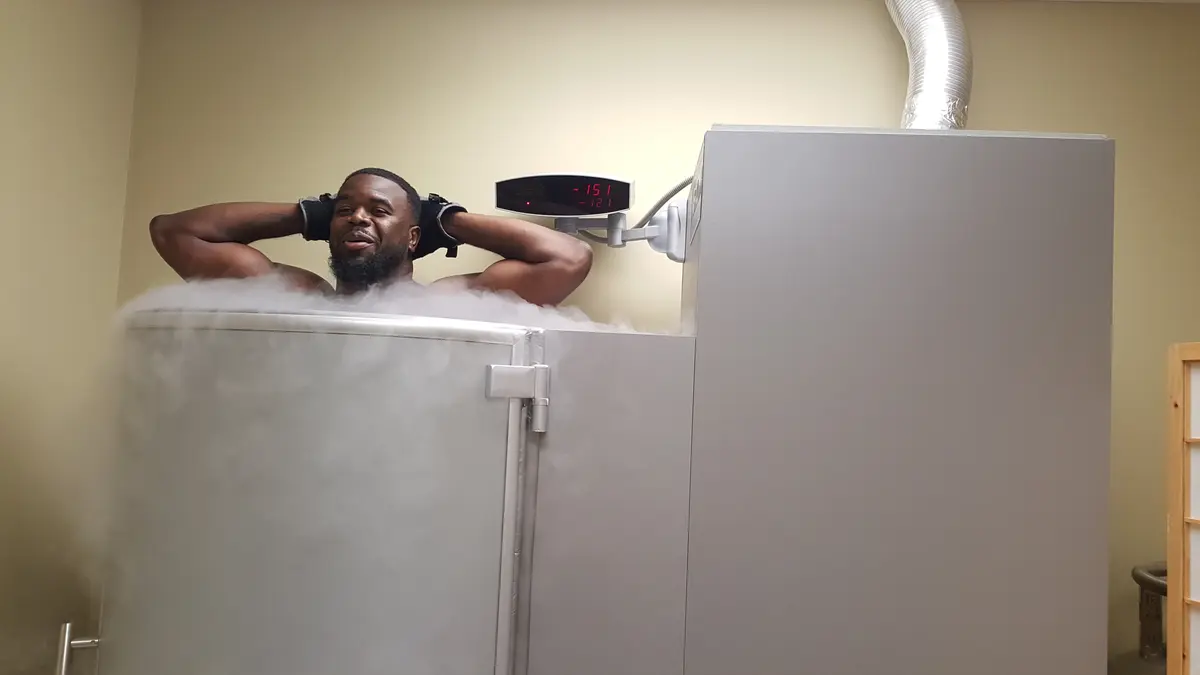
- Whole body. Minimal clothing (underwear; a sports bra for women), dry skin, and our thermal gloves, socks, slippers and ear protection. Your head stays above the cryosauna cabin, so you never breathe the vapour, and a technician is present throughout.
- Localized. Targeted cold air on your chosen zone, with no downtime.
How many sessions?
Some clients feel relief after one session. For chronic issues or athletic goals, most get more from 2–3 sessions per week, and your technician recommends a schedule. The 2022 rheumatoid arthritis trial used a similar rhythm: six sessions over two weeks. Since some benefits faded once sessions stopped, judge it on consistent use. See how often you should do cryotherapy.
What does it cost, and how does cryotherapy fit with medical care?
- Whole body: $40 first-time trial; $60 single; 5 for $275; 10 for $500; 15 for $720.
- Localized: $35 intro; $45 single; 5 for $200; 10 for $380; 15 for $525.
- Bundle & Save: add-ons from $30.
Prices are CAD plus 13% HST. Packages never expire and are tied to the purchaser; gift cards are available. Details: our pricing page.
A complement, never a replacement
Cryotherapy is a wellness service, not medical treatment. It does not replace diagnosis, physiotherapy or prescribed medicines, and you should never change medication without your physician. In the rheumatoid arthritis trials above, cryotherapy was added to physiotherapy or a rheumatology program, not used instead.
Cryotherapy for Inflammation FAQ
Does cryotherapy reduce inflammation?
Is cryotherapy good for swelling after an injury?
Can cryotherapy help rheumatoid arthritis or ankylosing spondylitis?
How many cryotherapy sessions do I need for inflammation?
Is whole body cryotherapy better than an ice pack for inflammation?
Can cryotherapy replace my anti-inflammatory medication?
Research we reviewed
- He J, Zhang X, Ge Z, Shi J, Guo S, Chen J. Whole-body cryotherapy can reduce the inflammatory response in humans: a meta-analysis based on 11 randomized controlled trials. Sci Rep. 2025;15(1):7759. pubmed.ncbi.nlm.nih.gov/40044835/
- Saidane O, Bouden S, Ben Dhia S, Rouached L, Mahmoud I, Tekaya R, et al. Efficacy of whole-body cryotherapy in ankylosing spondylitis: a systematic review with meta-analysis. J Integr Complement Med. 2026;32(2):134-142. pubmed.ncbi.nlm.nih.gov/41084233/
- Klemm P, Hoffmann J, Asendorf T, Aykara I, Frommer K, Dischereit G, et al. Whole-body cryotherapy for the treatment of rheumatoid arthritis: a monocentric, single-blinded, randomised controlled trial. Clin Exp Rheumatol. 2022;40(11):2133-2140. pubmed.ncbi.nlm.nih.gov/35238767/
- Hirvonen HE, Mikkelsson MK, Kautiainen H, Pohjolainen TH, Leirisalo-Repo M. Effectiveness of different cryotherapies on pain and disease activity in active rheumatoid arthritis. A randomised single blinded controlled trial. Clin Exp Rheumatol. 2006;24(3):295-301. pubmed.ncbi.nlm.nih.gov/16870097/
- Klemm P, Becker J, Aykara I, Asendorf T, Dischereit G, Neumann E, et al. Serial whole-body cryotherapy in fibromyalgia is effective and alters cytokine profiles. Adv Rheumatol. 2021;61(1):3. pubmed.ncbi.nlm.nih.gov/33436106/
- Guillot X, Tordi N, Prati C, Verhoeven F, Pazart L, Wendling D. Cryotherapy decreases synovial Doppler activity and pain in knee arthritis: a randomized-controlled trial. Joint Bone Spine. 2017;84(4):477-483. pubmed.ncbi.nlm.nih.gov/27825572/
- Dupuy O, Douzi W, Theurot D, Bosquet L, Dugué B. An evidence-based approach for choosing post-exercise recovery techniques to reduce markers of muscle damage, soreness, fatigue, and inflammation: a systematic review with meta-analysis. Front Physiol. 2018;9:403. pubmed.ncbi.nlm.nih.gov/29755363/
- Algafly AA, George KP. The effect of cryotherapy on nerve conduction velocity, pain threshold and pain tolerance. Br J Sports Med. 2007;41(6):365-369. pubmed.ncbi.nlm.nih.gov/17224445/