
Cold therapy is one of the most common things people try for a sore tendon. Here is what the research actually shows for Achilles, patellar, elbow and shoulder tendon pain, why exercise comes first, and when cryotherapy is worth adding.
Key takeaways
- Cryotherapy may ease tendon pain for a short time, mainly by slowing pain signals; a 2026 systematic review found it does not work as a standalone treatment for tendinopathy.
- Progressive loading exercise is the core treatment for Achilles, patellar, elbow and shoulder tendon pain in current reviews.
- In a tennis elbow trial, adding ice to an exercise program gave no extra pain relief; in a rotator cuff trial, cold eased resting and night pain over three days.
- Localized cryotherapy suits one sore tendon; whole body sessions suit athletes who also want general recovery.
- See a doctor first for a sudden snap or pop, a tendon you cannot load, or pain that keeps getting worse.
Does cryotherapy help tendonitis?
Quick answer: Cryotherapy may help tendonitis feel better for a short time, mostly by numbing pain, but it does not repair the tendon. A 2026 systematic review concluded that cold should not be a standalone or standard treatment for tendinopathy, though it may help as an add-on for short-term symptom relief. Progressive loading exercise remains the core treatment.
That is the answer the evidence supports, and it is how we explain tendon pain at our North York studio. Cold can make a sore Achilles, elbow or shoulder more comfortable between training sessions. It is a support act, not the main treatment.
Tendonitis or tendinopathy: what is actually going on?
“Tendonitis” is the everyday word for a painful tendon. Many clinicians and researchers now prefer tendinopathy, because long-standing tendon pain is usually linked to how much load the tendon has been asked to handle rather than to inflammation alone. The practical difference matters: a tendon that has been overloaded usually needs carefully graded loading to recover, not just rest and anti-inflammatory measures.
The tendons people most often ask about
- Achilles: back of the heel or lower calf, often stiff first thing in the morning.
- Patellar (jumper’s knee): just below the kneecap, common in jumping and running sports.
- Lateral elbow (tennis elbow): outside of the elbow, sore with gripping and lifting.
- Rotator cuff: top or side of the shoulder, sore with reaching overhead or lying on that side.
- Gluteal tendons: outer hip; see our guide to cryotherapy for hip pain.
Knee-specific symptoms are covered in knee tendonitis symptoms, and wrist and elbow overuse on our repetitive strain injury page.
What does the research say about cold therapy for tendon pain?
Most tendon studies use ice packs or cold-water immersion rather than studio cryotherapy, and most are small. Here is what the better studies we reviewed show.
| Study | Who or what | What it found | Keep in mind |
|---|---|---|---|
| Lima et al., 2026, systematic review | 12 human studies of cryotherapy and tendons | Short-term improvements in pain and tendon blood-flow measures | Not supported as a standalone or standard treatment; long-term benefit uncertain |
| Manias & Stasinopoulos, 2006 | 40 people with tennis elbow | Four weeks of eccentric exercise and stretching cut pain whether or not 10 minutes of ice was added | Ice added nothing measurable to the exercise program |
| Durgut et al., 2024, randomised trial | 52 people with rotator cuff tendonitis | Cold therapy reduced resting and night pain over three days | Kinesio taping did better for activity pain and function; both groups exercised |
| Knobloch et al., 2006, laboratory study | 26 people, Achilles tendon | Cold with compression lowered tendon blood flow while it was applied | Measures circulation, not pain or recovery from tendinopathy |
| Bleakley et al., 2004, systematic review | 22 trials of acute soft-tissue injury | Marginal evidence that ice combined with exercise was most effective | No evidence for an ideal type or length of cold treatment |
| Algafly & George, 2007 | 23 male athletes, ankle cooling | Cold slowed nerve conduction and raised pain threshold and tolerance | Explains short-term pain relief, not tendon repair |
Whole body cryotherapy has even less tendon-specific research. A 2024 orthopaedic review lists tendinopathies among the conditions where whole body cryotherapy has been explored, reports a spectrum of results, and calls for more standardised studies (Jeyaraman et al., 2024).
Achilles, patellar, elbow or shoulder: how does cold fit each tendon?
| Tendon | What the reviews put first | Where cold may fit |
|---|---|---|
| Achilles | Progressive calf and tendon loading, guided by a physiotherapist | Comfort after runs or loading sessions; cold lowers local blood flow while it is applied |
| Patellar | Structured tendon-loading exercise, recommended as first-line care (Bruna-Mejias et al., 2026) | Settling soreness after jumping or training days |
| Tennis elbow | Eccentric strengthening and stretching | Optional; ice added nothing to exercise in the one trial we found |
| Rotator cuff | Shoulder exercises, a reasonable first-line approach (Lazzarini et al., 2026) | Resting and night pain in the short term |
For shoulder problems that are not tendon-related, such as frozen shoulder, see our shoulder pain page.
Why does exercise come first, and where does cryotherapy fit around it?
A 2026 review of isometric exercise for tendinopathy described exercise as the cornerstone of management, with the best type still debated (Soliman et al., 2026). Tendons adapt to load, so the goal of rehab is to build capacity gradually, and pain relief is useful mainly because it makes that work easier to do.
Sensible ways to use cold around a tendon program
- After loading sessions to settle soreness, rather than right before them.
- For night or resting pain that is disturbing sleep, as in the rotator cuff trial above.
- During a flare-up, while you scale training back with your physiotherapist rather than stopping completely.
One caution: numbing a tendon right before hard training can hide warning signs. If cold lets you push through pain you would otherwise respect, that is a reason to talk to your physiotherapist, not to train harder.
Localized or whole body cryotherapy for tendon pain?
| Localized cryotherapy | Whole body cryotherapy | |
|---|---|---|
| What is cooled | One zone: Achilles and ankle, knee, elbow, wrist, shoulder or hip | The whole body, head above an open-top cryosauna |
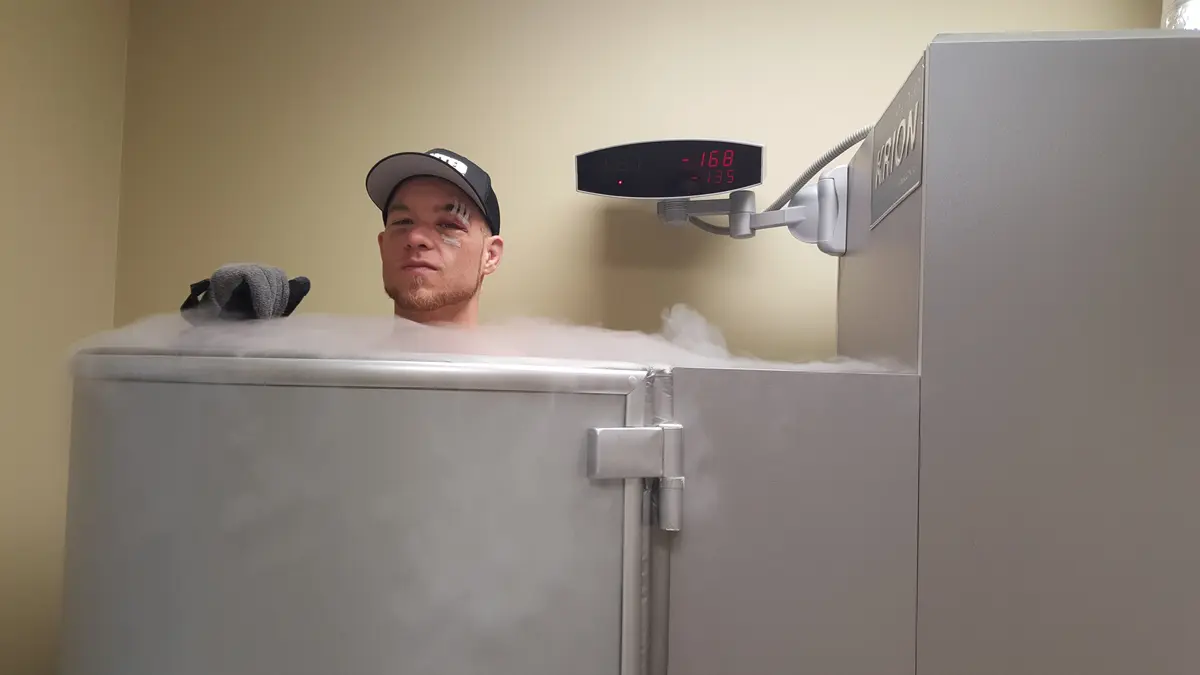
| Session | Targeted cold air, quick, no downtime | −110°C to −195°C for 2–3 minutes |
| Tends to suit | One sore tendon | Athletes wanting general recovery as well |
| Price (CAD + HST) | $35 intro, $45 single | $40 trial, $60 single |
For a single tendon, localized cryotherapy is the logical place to start. Athletes juggling a sore tendon with heavy training often add whole body sessions; our sports recovery page explains how those fit a training week.
Ice pack, cold plunge or studio cryotherapy: which makes sense for tendonitis?
The research does not name a winner, so the choice comes down to convenience, comfort and cost.
- Ice pack: cheap and easy for an elbow or Achilles; most tendon studies used ice, so it is a legitimate option. Protect the skin and keep sessions short.
- Cold plunge: cools a whole limb or the body; wet and hard for some people to tolerate.
- Localized cryotherapy: dry, targeted cold set by a trained technician, done in minutes.
- Whole body cryotherapy: useful if you want overall recovery as well as relief for one tendon.
If an ice pack after training gives you enough relief, keep using it. Our cryotherapy vs ice bath comparison covers the differences in more detail.
When should tendon pain be checked by a doctor or physiotherapist?
Get a medical assessment before trying cryotherapy if:
- you felt a sudden snap or pop, or the tendon area suddenly became weak;
- you cannot put weight through the leg or lift the arm;
- the area is hot, red and swollen, or you feel unwell or feverish;
- the pain is getting steadily worse, or has not improved after several weeks of sensible rest and exercise.
Cryotherapy also has contraindications, including uncontrolled high blood pressure, serious heart conditions, Raynaud’s, cold urticaria, open wounds and pregnancy. Read the full contraindications list and our side effects and safety guide.
What does a tendon session look like at our North York studio, and what does it cost?
Your first visit at 4646 Dufferin St, North York, takes about 30 minutes and starts with a free one-on-one consultation: your health history, which tendon is sore, any diagnosis, your training and your goals. A trained technician then applies targeted cold air to the area, and there is no downtime afterwards.
Some people feel relief after one session. For a long-standing tendon problem we usually suggest 2–3 sessions a week alongside your exercise program, and the technician recommends a schedule.
| Option (CAD + 13% HST) | Localized | Whole body |
|---|---|---|
| First visit | $35 intro | $40 trial |
| Single session | $45 | $60 |
| 10 sessions | $380 | $500 |
Packages never expire. Full details are on our prices page, and you can book a first visit online or by phone.
Frequently asked questions
Is ice good for tendonitis?
Can cryotherapy help Achilles tendonitis?
Does cryotherapy work for tennis elbow?
How often should I do cryotherapy for tendonitis?
Should I use heat or cold for tendonitis?
Can I train after a cryotherapy session for tendon pain?
Sources & further reading
- Lima TA, Rocha TS, Bezerra MA, Oliveira RR. Is cryotherapy effective for tendon health? A systematic review of evidence and methodological limitations. J Bodyw Mov Ther. 2026;46:346-355. pubmed.ncbi.nlm.nih.gov/41927193/
- Manias P, Stasinopoulos D. A controlled clinical pilot trial to study the effectiveness of ice as a supplement to the exercise programme for the management of lateral elbow tendinopathy. Br J Sports Med. 2006;40(1):81-85. pubmed.ncbi.nlm.nih.gov/16371498/
- Durgut E, Gurses HN, Bilsel K, et al. Short-term effects of cold therapy and Kinesio taping on pain relief and upper extremity functionality in individuals with rotator cuff tendonitis: a randomized study. Medicina (Kaunas). 2024;60(8):1188. pubmed.ncbi.nlm.nih.gov/39202470/
- Knobloch K, Grasemann R, Jagodzinski M, et al. Changes of Achilles midportion tendon microcirculation after repetitive simultaneous cryotherapy and compression using a Cryo/Cuff. Am J Sports Med. 2006;34(12):1953-1959. pubmed.ncbi.nlm.nih.gov/16998082/
- Bleakley C, McDonough S, MacAuley D. The use of ice in the treatment of acute soft-tissue injury: a systematic review of randomized controlled trials. Am J Sports Med. 2004;32(1):251-261. pubmed.ncbi.nlm.nih.gov/14754753/
- Algafly AA, George KP. The effect of cryotherapy on nerve conduction velocity, pain threshold and pain tolerance. Br J Sports Med. 2007;41(6):365-369. pubmed.ncbi.nlm.nih.gov/17224445/
- Bruna-Mejias A, Cañas-Jamett R, Valenzuela Fuenzalida JJ, et al. Exercise loading strategies for patellar tendinopathy: a systematic review and meta-analysis of clinical outcomes. J Funct Morphol Kinesiol. 2026;11(3):348. pubmed.ncbi.nlm.nih.gov/42783641/
- Lazzarini SG, Bettariga F, Mosconi B, et al. Comparative effectiveness of physical therapy interventions in adults with rotator cuff tendinopathy: a systematic review and network meta-analysis. Br J Sports Med. 2026;60(13):970-982. pubmed.ncbi.nlm.nih.gov/42135016/
- Soliman EFF, Nagra D, Goh SL, et al. Isometric exercises for tendinopathies: a systematic literature review. Clin Ther. 2026;48(10):952-957. pubmed.ncbi.nlm.nih.gov/42203537/
- Jeyaraman M, Migliorini F, Balaji S, et al. Whole-body cryotherapy in orthopaedics: current concepts. Eur J Orthop Surg Traumatol. 2024;34(5):2245-2254. pubmed.ncbi.nlm.nih.gov/38630298/
Try cryotherapy in Toronto
New clients start with a $40 first visit including a free one-on-one consultation. 4646 Dufferin St, North York · Since 2013 · 15,000+ sessions · 5.0★ from 135+ Google reviews.