Red light therapy is everywhere, but which benefits actually hold up? Our North York team rates the research on skin, pain, hair loss and recovery, and explains dosing, safety and how it compares with cryotherapy and the Cryofacial.
Key takeaways
- Red light therapy (photobiomodulation) uses red (~630–700 nm) and near-infrared (~800–850 nm) light; the leading hypothesis is that mitochondrial cytochrome c oxidase absorbs it.
- The best evidence is for skin texture and collagen, some musculoskeletal pain, and hair density with dedicated scalp devices. Evidence for acne, recovery, mood and sleep is weaker.
- Results come from consistent sessions over weeks. Because of a biphasic dose response, more light is not automatically better.
- It is generally well tolerated, but protect your eyes and check photosensitising medications, pregnancy and skin cancer history with a physician.
- Red light, cryotherapy and the Cryofacial suit different goals; there is no good evidence that combining them multiplies the benefits.
What are the real benefits of red light therapy?
Quick answer: Red light therapy (photobiomodulation) has its most consistent research support for improving skin texture and fine lines, easing some musculoskeletal pain, and increasing hair density in pattern hair loss when dedicated scalp devices are used. Evidence for acne, workout recovery, mood and sleep is weaker or mixed, and results depend on dose and consistency.
We have run Cryotherapy Toronto in North York since 2013, and red light therapy sits alongside our cryotherapy and compression services. Because it is a health topic, you deserve a straight answer about what the science actually supports.
Below, we explain what red light therapy is, how it is thought to work, and rate each claimed benefit by the strength of the evidence. If you are weighing up red light therapy in Toronto, start here.
What is red light therapy (photobiomodulation)?
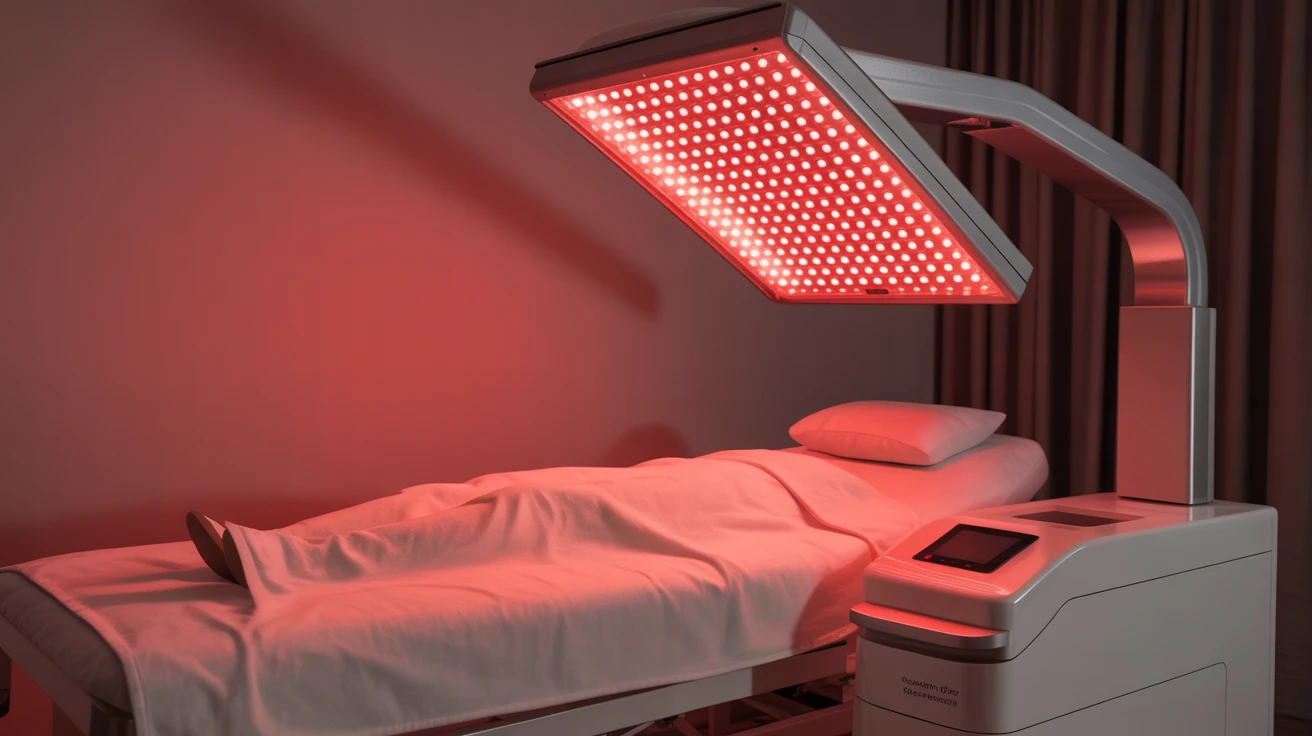
Red light therapy exposes the skin to low-intensity red and near-infrared light, usually from LEDs or low-level lasers. In research it goes by several names: photobiomodulation (PBM), low-level laser (light) therapy (LLLT) and LED therapy. It is not a tanning bed. It does not use ultraviolet light, and at therapeutic doses it is designed to be non-thermal, meaning it should not heat or burn tissue.
Red light vs near-infrared: what is the difference?
- Red light (~630–700 nm) is visible and is absorbed mostly in the skin, which is why it dominates skin-focused studies.
- Near-infrared (~800–850 nm) is invisible to the eye and generally penetrates deeper into tissue, so it appears more often in muscle and joint research.
Our red light therapy service uses wavelengths from 630 to 850 nm, so one session covers both red and near-infrared light. Sessions run 10–20 minutes.
How does red light therapy work?
The leading hypothesis centres on mitochondria, the energy-producing structures inside cells. In a 2017 review in AIMS Biophysics, Michael Hamblin of the Wellman Center for Photomedicine at Massachusetts General Hospital identifies cytochrome c oxidase, an enzyme in the mitochondrial energy chain, as a primary light-absorbing target, along with light-sensitive calcium ion channels.
According to that review, light absorption is followed by a rise in cellular energy (ATP), a brief burst of reactive oxygen species, more nitric oxide and changes in calcium signalling. These in turn switch on pathways linked to cell survival, repair and lower inflammation. Much of this mechanistic work comes from cell and animal studies, so it explains why researchers are interested, not what any one person will feel.
Why more light is not always better
The same review describes a pronounced biphasic dose response: low doses of light tend to stimulate, while high doses can be inhibitory. In practical terms, longer or more frequent sessions are not automatically better, which is why sessions are timed rather than open-ended.
Red light therapy benefits: how strong is the evidence?
Here is our honest summary by benefit. Moderate means several controlled trials or meta-analyses point the same way, with caveats. Limited means small, early or inconsistent findings. Weak means little quality human research.
| Claimed benefit | Evidence strength | What the research suggests |
|---|---|---|
| Skin texture, fine lines and collagen | Moderate | Controlled trials report smoother skin, better complexion and higher collagen density after a course of sessions. |
| Acne | Limited | A Cochrane review found high-quality evidence lacking; many trials tested blue light or light plus prescription creams. |
| Hair loss (androgenetic alopecia) | Moderate | Sham-controlled trials show increased hair density with dedicated laser comb and helmet devices. |
| Joint and musculoskeletal pain | Moderate, but mixed | A meta-analysis found less pain than control, with wide variation between studies. |
| Exercise performance and muscle recovery | Limited to moderate | Small gains, mostly when light is applied to muscles before exercise. |
| Wound healing | Moderate (medical settings) | Faster healing of diabetic foot ulcers in trials run under clinical care. |
| Mood, sleep and energy | Weak | Very few quality human trials; not a good reason to start on its own. |
Does red light therapy work for skin, wrinkles and acne?
Fine lines, wrinkles and collagen
Skin is where red light research is most developed. In a 2014 controlled trial of 136 volunteers, Wunsch and Matuschka treated participants twice a week for 30 sessions with large-area red (611–650 nm) or broader 570–850 nm light. Compared with untreated controls, the treated groups showed improved complexion and skin roughness, higher collagen density on ultrasound, and better scores in blinded photo assessments.
Two details matter. The broader red/near-infrared spectrum showed no advantage over red alone for skin, and the results came after roughly 15 weeks of regular sessions, not one visit. A 2013 review by Avci and colleagues reached a similar overall view, describing beneficial effects on wrinkles, acne scars and hypertrophic scars while noting that more testing is needed.
Acne
Acne is where we urge caution. A 2016 Cochrane review of 71 trials with 4,211 participants concluded that high-quality evidence on light therapies for acne is lacking. Many of those trials used blue light or photodynamic therapy, which pairs light with a prescription photosensitising cream, and that is quite different from a wellness red light session.
If acne is your main concern, start with a dermatologist. Red light can be discussed as an add-on, but it is not a substitute for proven acne treatment.
Can red light therapy help with pain, muscle recovery or hair loss?
Joint and musculoskeletal pain
A 2017 meta-analysis by Clijsen and colleagues pooled 18 studies (1,462 participants) with musculoskeletal disorders and found that low-level laser therapy reduced pain compared with control. Differences between studies were large, and trials that followed World Association of Laser Therapy dosing recommendations tended to do better. These were laser studies with defined doses, so results do not automatically transfer to every LED device.
Exercise performance and muscle recovery
A 2015 meta-analysis by Leal-Junior and colleagues reviewed 13 randomised trials of acceptable quality on laser and LED therapy around exercise. Light applied before exercise increased repetitions by about five and time to exhaustion by about four seconds compared with placebo. The most consistent results came from red or near-infrared light at specific doses per treatment point. Recovery markers varied too much to pool, so we call this promising rather than settled.
Hair loss (androgenetic alopecia)
A 2019 meta-analysis of 11 double-blind randomised trials found that low-level laser therapy increased hair density versus sham devices in both men and women, using comb- and helmet-type devices. The authors flagged differences between trials. These were dedicated scalp devices on a set schedule, so a general red light session is not the same thing. For hair loss, talk to a dermatologist about scalp-specific options.
Wound healing
A 2021 meta-analysis of 12 randomised trials found that low-level light therapy reduced ulcer size and improved complete healing in diabetic foot ulcers. That is medical wound care under clinical teams, and a wellness studio is not the place for open wounds.
Mood, sleep and energy
Red light is often marketed for sleep, mood and energy. We have not found quality human research strong enough to support those claims, so we do not sell it on them.
How often should you do red light therapy?
Consistency over weeks matters more than any single session. Protocols vary widely between studies, but a few patterns show up:
- Session length: our sessions run 10–20 minutes, in line with typical clinic protocols.
- Frequency: many studies use several sessions per week. The 2014 skin trial used two a week for 30 sessions.
- Timeline: skin and hair studies measure change over weeks to months, not days.
- No shortcuts: because of the biphasic dose response, doubling up sessions is not a way to speed things up.
For chronic issues or athletic goals, our general guidance across services is 2–3 sessions per week, and your technician will recommend a schedule at your first visit. Protocols differ by device and goal, so treat any number online, including ours, as a starting point.
Red light therapy side effects: is it safe?
In research, red light therapy is generally well tolerated, but that is not the same as risk-free. Reporting of side effects in trials is often poor: the Cochrane acne review rated its adverse-effect evidence as very low quality, and noted blistering only in studies of some higher-intensity light devices (such as intense pulsed light) and photodynamic therapy. Standard practice covers the following:
- Protect your eyes. Wear eye protection and do not stare into the light.
- Photosensitising medications. Some antibiotics, acne medications and other drugs make skin more sensitive to light. Tell your technician what you take and check with your pharmacist or physician.
- Light-sensitive conditions. Conditions such as lupus or porphyria, or any history of light-triggered skin reactions, need medical advice first.
- Pregnancy and skin cancer. Research in pregnancy is limited, and anyone with a history of skin cancer or a changing mole should consult their physician before light treatment.
Contraindications are reviewed with every new client at a free consultation. If you are unsure, ask your physician first.
Red light therapy vs cryotherapy vs Cryofacial: what is the difference?
Our studio centres on cold therapies and pain management, and red light works very differently. Here is how the four compare:
| Red light therapy | Whole body cryotherapy | Localized cryotherapy | Cryofacial | |
|---|---|---|---|---|
| How it works | Red and near-infrared light (630–850 nm), not designed to heat tissue | Open-top nitrogen-vapour cabin at −110°C to −195°C | Targeted cold air on one zone, such as a knee, shoulder, back or neck | Cold air applied to the face |
| Session length | 10–20 min | 2–3 min (capped at 3) | Set by your technician | Set by your technician |
| What it feels like | Soft light, little or no heat | Intense, dry cold; your head stays above the cabin | Concentrated cold on one area | Brisk cold; no downtime |
| How clients tend to use it | Skin and joint goals, as a regular routine | Short, acute cold stimulus around training or for aches | One problem area | Skin and facial refresh |
| Price (CAD + 13% HST) | Ask the studio | $40 first-time trial; $60 single | $35 intro; $45 single | $35 intro; $45 single |
| Screening | Eyes, photosensitising medications, light-sensitive conditions | Full contraindication review (heart, circulation, pregnancy and more) | Same review, including cold allergy and Raynaud's | Same review, including cold allergy and Raynaud's |
How clients combine them
Some clients use whole body cryotherapy for a short, acute cold stimulus after training, localized cryotherapy for a single sore knee or shoulder, and red light for ongoing skin or joint goals. Others pair red light with a Cryofacial for skin. Our Bundle & Save add-ons let you add a Cryofacial or Localized session to a visit from $30.
We treat these as separate tools; no good trials show that stacking them multiplies the benefits, so we do not promise synergy.
One more honest data point: a 2022 meta-analysis comparing post-exercise light therapy with cryotherapy found light came out ahead on strength, soreness and muscle-damage markers. It included only four small trials (66 people), with certainty rated moderate to very low. We read that as a reason to keep studying both, not to crown a winner. For more, see our guides to cryotherapy and muscle soreness and localized cryotherapy.
Where can you try red light therapy in Toronto?
Our studio is at 4646 Dufferin St, Unit 3, Suite 23, North York. Cryotherapy Toronto is family-owned and independently operated, and has been since Roman Gersh founded it in 2013 as one of Ontario's first dedicated cryotherapy centres. We have delivered 15,000+ sessions and hold a 5.0★ Google rating from 135+ reviews.
Your first visit takes about 30 minutes and starts with a free one-on-one consultation: we review your health history and contraindications, talk through your goals and build a personalised plan. Learn more about red light therapy in Toronto on our service page, see packages on our pricing page, or contact the studio at (416) 509-4555 to ask about red light pricing and book.
Frequently asked questions
How long does red light therapy take to work?
Do I need eye protection for red light therapy?
Is red light or near-infrared light better?
Can I do red light therapy and cryotherapy on the same day?
Does red light therapy tan your skin?
How much does red light therapy cost in Toronto?
Sources & further reading
- Hamblin MR. Mechanisms and applications of the anti-inflammatory effects of photobiomodulation. AIMS Biophys. 2017;4(3):337-361. pubmed.ncbi.nlm.nih.gov/28748217/
- Wunsch A, Matuschka K. A controlled trial to determine the efficacy of red and near-infrared light treatment in patient satisfaction, reduction of fine lines, wrinkles, skin roughness, and intradermal collagen density increase. Photomed Laser Surg. 2014;32(2):93-100. pubmed.ncbi.nlm.nih.gov/24286286/
- Avci P, Gupta A, Sadasivam M, et al. Low-level laser (light) therapy (LLLT) in skin: stimulating, healing, restoring. Semin Cutan Med Surg. 2013;32(1):41-52. pubmed.ncbi.nlm.nih.gov/24049929/
- Barbaric J, Abbott R, Posadzki P, et al. Light therapies for acne. Cochrane Database Syst Rev. 2016;9(9):CD007917. pubmed.ncbi.nlm.nih.gov/27670126/
- Clijsen R, Brunner A, Barbero M, et al. Effects of low-level laser therapy on pain in patients with musculoskeletal disorders: a systematic review and meta-analysis. Eur J Phys Rehabil Med. 2017;53(4):603-610. pubmed.ncbi.nlm.nih.gov/28145397/
- Leal-Junior EC, Vanin AA, Miranda EF, et al. Effect of phototherapy (low-level laser therapy and light-emitting diode therapy) on exercise performance and markers of exercise recovery: a systematic review with meta-analysis. Lasers Med Sci. 2015;30(2):925-939. pubmed.ncbi.nlm.nih.gov/24249354/
- Liu KH, Liu D, Chen YT, Chin SY. Comparative effectiveness of low-level laser therapy for adult androgenic alopecia: a system review and meta-analysis of randomized controlled trials. Lasers Med Sci. 2019;34(6):1063-1069. pubmed.ncbi.nlm.nih.gov/30706177/
- Zhou Y, Chia HWA, Tang HWK, et al. Efficacy of low-level light therapy for improving healing of diabetic foot ulcers: a systematic review and meta-analysis of randomized controlled trials. Wound Repair Regen. 2021;29(1):34-44. pubmed.ncbi.nlm.nih.gov/33078478/
- Ferlito JV, Ferlito MV, Leal-Junior ECP, et al. Comparison between cryotherapy and photobiomodulation in muscle recovery: a systematic review and meta-analysis. Lasers Med Sci. 2022;37(3):1375-1388. pubmed.ncbi.nlm.nih.gov/34669081/
Try cryotherapy in Toronto
New clients start with a $40 first visit including a free one-on-one consultation. 4646 Dufferin St, North York · Since 2013 · 15,000+ sessions · 5.0★ from 135+ Google reviews.